- Home
Edition
Africa Australia Brasil Canada Canada (français) España Europe France Global Indonesia New Zealand United Kingdom United States Edition:
Global
Edition:
Global
- Africa
- Australia
- Brasil
- Canada
- Canada (français)
- España
- Europe
- France
- Indonesia
- New Zealand
- United Kingdom
- United States
Academic rigour, journalistic flair
 EPA/Sarah Yenesel
‘It’s wanting to know that makes us matter’: how Tom Stoppard made us all philosophers
Published: December 1, 2025 12.32am GMT
Fergus Edwards, University of Tasmania
EPA/Sarah Yenesel
‘It’s wanting to know that makes us matter’: how Tom Stoppard made us all philosophers
Published: December 1, 2025 12.32am GMT
Fergus Edwards, University of Tasmania
Author
-
 Fergus Edwards
Lecturer in English, University of Tasmania
Disclosure statement
Fergus Edwards does not work for, consult, own shares in or receive funding from any company or organisation that would benefit from this article, and has disclosed no relevant affiliations beyond their academic appointment.
Partners

University of Tasmania provides funding as a member of The Conversation AU.
View all partners
DOI
https://doi.org/10.64628/AA.gcawcseh5
https://theconversation.com/its-wanting-to-know-that-makes-us-matter-how-tom-stoppard-made-us-all-philosophers-270952 https://theconversation.com/its-wanting-to-know-that-makes-us-matter-how-tom-stoppard-made-us-all-philosophers-270952 Link copied Share articleShare article
Copy link Email Bluesky Facebook WhatsApp Messenger LinkedIn X (Twitter)Print article
Tom Stoppard, who has died at 88, was one of the most critically acclaimed and commercially successful playwrights of our age. He won his first Tony Award for Rosencrantz and Guildenstern Are Dead in 1968, and his last for Leopoldstadt in 2023.
His life was extraordinary. Born Tomáš Straussler in Zlín, Czechoslovakia, in 1937, his Jewish family fled Nazi occupation to India and then England. He chose to become a journalist rather than go to university, and became close friends with Nobel Prize winners, presidents – and Mick Jagger.
The wit and intellectual curiosity of Stoppard’s plays was so distinctive that “Stoppardian” entered the Oxford English Dictionary in 1978. Hermione Lee’s biography of him contains a cartoon with annoyed audience members hissing: “Look at the Jones’s pretending to get all the jokes in a Stoppard play.”
Stoppard just assumed his audience was as well read and inquisitive as he was.
Philosophy is the foundation
As Stoppard said to American theatre critic Mel Gussow in 1974,
most of the propositions I’m interested in have been kidnapped and dressed up by academic philosophy, but they are in fact the kind of proposition that would occur to any intelligent person in his bath.
Philosophy is the foundation of Stoppard’s plays. They cite Aquinas, Aristotle, Ayer, Bentham, Kant, Moore, Plato, Ramsey, Russell, Ryle and Zeno. One philosopher in Stoppard’s radio play Darkside (2013) is never sure if he is spelling Nietzsche correctly.
In 2003, the actor Simon Russell-Beale recalled to a National Theatre audience Stoppard introducing a cast to
2,000 years of philosophy in an hour – it was rather brilliant – just to explain what the debate was and why it was dramatically exciting.
Philosophy – but not before life
Stoppard’s interest in philosophy began in 1968. He wrote to a friend that he was
in a ridiculous philosophy\logic\math kick. I don’t know how I got into it, but you should see me […] following Wittgenstein through Tractatus Logico-Philosophicus.
The Austro-British philosopher Ludwig Wittgenstein (1889–1951) had a philosophy of philosophy. He argued lots of academic philosophy was literal nonsense. Some things we think are important are beyond words.
Stoppard saw theatre similarly, saying in a lecture to Canadian students in 1988 that “theatre is a curious equation in which language is merely one of the components”.
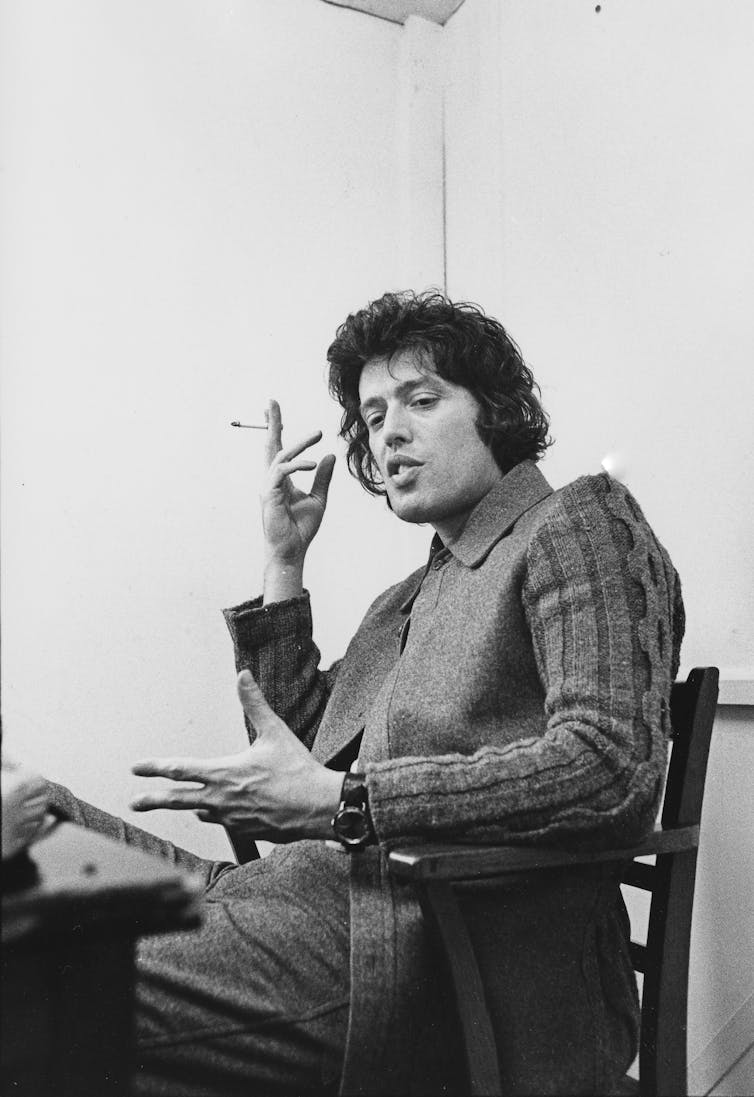 Stoppard as a young playwright in 1972.
Clive Barda/Radio Times/Getty Images
Stoppard as a young playwright in 1972.
Clive Barda/Radio Times/Getty Images
Stoppard wrote philosophers who tie themselves into cerebral knots failing to prove what they want to believe about God, morals or consciousness in plays such as Jumpers (1972), Rock ‘n’ Roll (2006) and The Hard Problem (2015).
One of Stoppard’s philosophers dictates a lecture in Jumpers, saying “to begin at the beginning: is God? (To SECRETARY). Leave a space”.
Stoppard’s plays sympathise with this forlorn desire to know until it leads characters to ignore other people. Action in the world is more important than the search for knowledge if there is a marriage to be saved, a dying wife to be cared for, or an adopted child to be found. Wittgenstein’s Lecture on Ethics is complex – but Stoppard’s plays show it in effect.
What we know, and how
In his TV play Professional Foul (1977), Stoppard sent philosophers to a conference in Prague. Scholarly debate was contained by totalitarian censorship. The professor of ethics at Cambridge University makes his call for action by riffing on Wittgenstein’s Tractatus: “Whereof we cannot speak, thereof we are by no means silent.”
Stoppard also staged lines from Wittgenstein’s Philosophical Investigations in Dogg’s Hamlet, Cahoot’s Macbeth (1979). Some characters speak English, others use the same words but with different meanings. The audience observes and learns this new nonsense language, laughing at its jokes. They understand the philosophy of language as Wittgenstein did: social conventions between people, not words pinned on things.
What we can know, and how, is crucial to Stoppard’s plays even when the immediate subject matter isn’t philosophy.
It might be quantum physics in Hapgood (1988) or chaos theory in Arcadia (1993); European history in The Coast of Utopia (2002) or contemporary politics in Rock ‘n’ Roll; individual consciousness in The Hard Problem or even whatever we might mean by “love” in The Real Thing (1982). The characters really do want to know. They debate and interrogate but never find definite answers.
As Hannah suggests in Arcadia:
It’s all trivial […] Comparing what we’re looking for misses the point. It’s wanting to know that makes us matter. Otherwise we’re going out the way we came in.
But there are jokes too. Arcadia opens in 1809 with a precocious 13-year-old girl asking her dashing 22-year-old tutor: “Septimus, what is carnal embrace?” before the tutor (originally played by a smoldering Rufus Sewell) pauses, and cautiously replies “Carnal embrace is the practice of throwing one’s arms around a side of beef”.
The audience erupted in laughter. I was one of them.
And as the play draws to a close, a waltz in 1809 happens in the same room as a waltz in the present. As the two dancing couples circle each other, Stoppard’s play suggests that what one person can share with another is more meaningful than justified true belief.
It is a beautiful, theatrical moment. And it is beyond words.
- Philosophy
- Theatre
- Obituary
- Playwriting
- Wittgenstein
- Tom Stoppard
- Theatre and performance
Events
Jobs
-
 Lecturer in Paramedicine
-
Lecturer/Senior Lecturer - Electrical Engineering
-
University Lecturer in Early Childhood Education
-
Case Specialist, Student Information and Regulatory Reporting
-
Associate Lecturer, Social Work
 Lecturer in Paramedicine
 Lecturer/Senior Lecturer - Electrical Engineering
 University Lecturer in Early Childhood Education
 Case Specialist, Student Information and Regulatory Reporting
 Associate Lecturer, Social Work
- Editorial Policies
- Community standards
- Republishing guidelines
- Analytics
- Our feeds
- Get newsletter
- Who we are
- Our charter
- Our team
- Partners and funders
- Resource for media
- Contact us
-
-
-
-
Copyright © 2010–2025, The Conversation