BTC 72,807.00 +6.62%
ETH 2,134.55 +7.66%
S&P 500 6,869.50 +0.78%
Dow Jones 48,739.41 +0.49%
Nasdaq 22,807.48 +1.29%
VIX 21.15 -10.27%
EUR/USD 1.09 +0.15%
USD/JPY 149.50 -0.05%
Gold 5,151.60 +0.33%
Oil (WTI) 76.11 +1.94%
BTC 72,807.00 +6.62%
ETH 2,134.55 +7.66%
S&P 500 6,869.50 +0.78%
Dow Jones 48,739.41 +0.49%
Nasdaq 22,807.48 +1.29%
VIX 21.15 -10.27%
EUR/USD 1.09 +0.15%
USD/JPY 149.50 -0.05%
Gold 5,151.60 +0.33%
Oil (WTI) 76.11 +1.94%

AMD details Ryzen AI 400 desktop with up to 8 cores, Radeon 860M graphics — APUs won’t be available as boxed units, only in OEM systems

| 2 Min Read
After announcing Ryzen AI 400 APUs earlier this year, AMD has finally revealed the specifications for the chips. However, they’re targeting OEM systems, and they top out lower than AMD’s Ryzen AI 400 ...

AMD details Ryzen AI 400 desktop with up to 8 cores, Radeon 860M graphics — APUs won’t be available as boxed units, only in OEM systems

Desktop Ryzen AI 400 from AMD.
(Image credit: AMD)

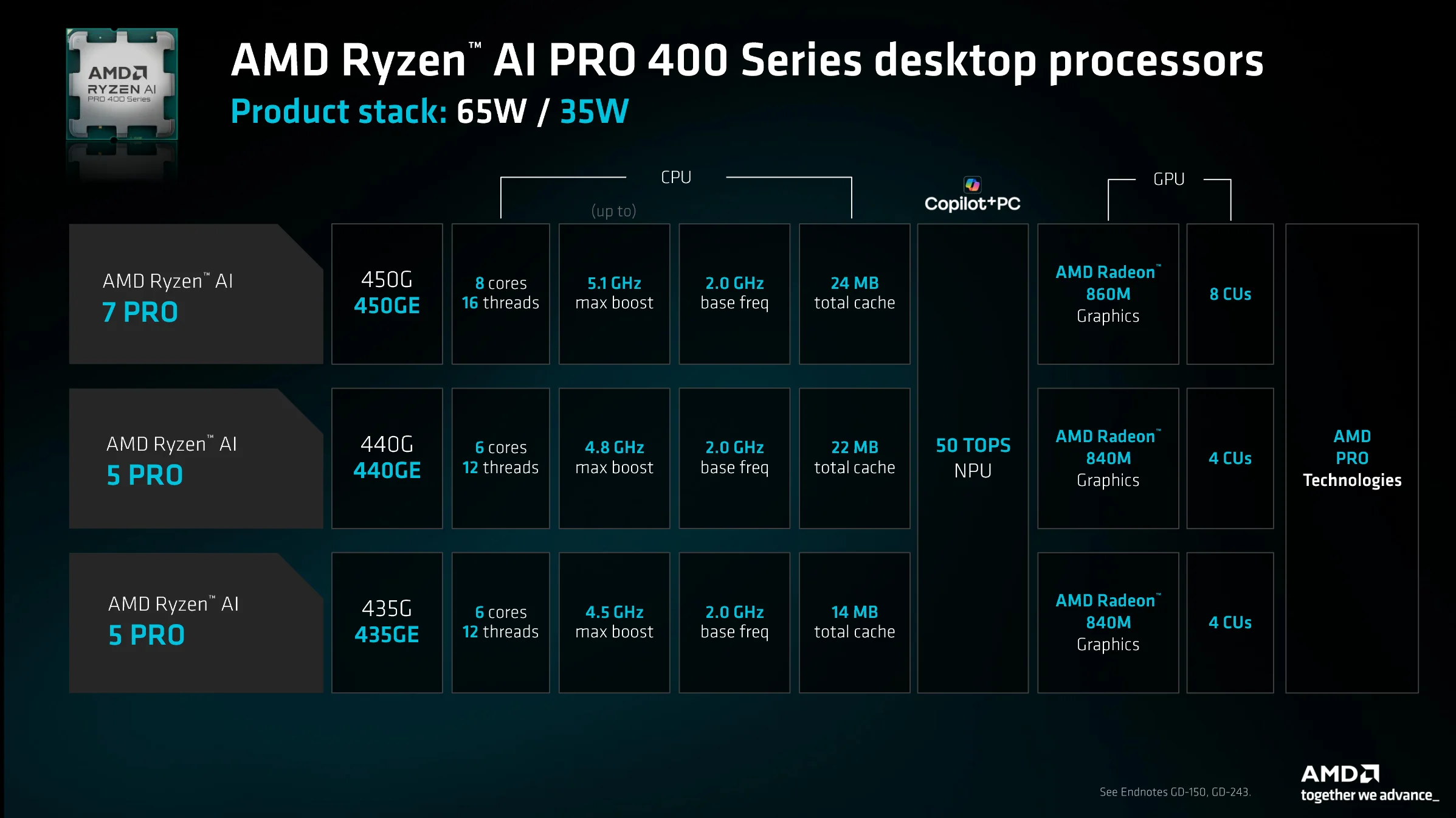
After teasing desktop Ryzen AI 400 processors at the beginning of the year, AMD has finally provided details on its new (but slim) desktop product stack. Previously known as “Gorgon Point,” the desktop range shares DNA with the Ryzen AI 400 mobile lineup, carrying the same Zen 5 CPU cores and RDNA 3.5 graphics with a focus on power efficiency over peak performance. AMD is offering two variations of the processors, one with the PRO designation for enterprise and another without it, but neither will be available as boxed retail units. At this time, they’ll only show up in OEM systems.

Swipe to scroll horizontally
Header Cell - Column 0

Cores / Threads

Frequency (Base / Boost)

Cache (L2 + L3)

NPU TOPS

Graphics (CUs)

TDP

Ryzen AI 7 450G / 450GE

8 /16

2 GHz / 5.1 GHz

24MB

50

Radeon 860M (8 CUs)

65W / 35W

Ryzen AI 5 440G / 440GE

6 / 12

2 GHz / 4.8 GHz

22MB

50

Radeon 840M (4 CUs)

65W / 35W

Ryzen AI 5 435G / 435GE

6 / 12

2 GHz / 4.5 GHz

14MB

50

Radeon 840M (4 CUs)

65W / 35W

AMD is using a 65W TDP for these chips, and the 35W versions are noted with an “E” suffix (i.e. Ryzen AI 7 450GE). Otherwise, the specs are identical, from the core counts and iGPU to the maximum boost clock speeds.

The differentiator compared to AMD’s other consumer chips is the 50 TOPS NPU, earning them Microsoft’s Copilot+ certification. The silicon here, including the NPU, GPU, and CPU, is identical to the mobile Ryzen AI 400 lineup. The 450 on desktop is identical to the 450 on mobile, short of the power limit and form factor. As with all Zen 5 chips, Ryzen AI 400 desktop CPUs slot into the AM5 socket.
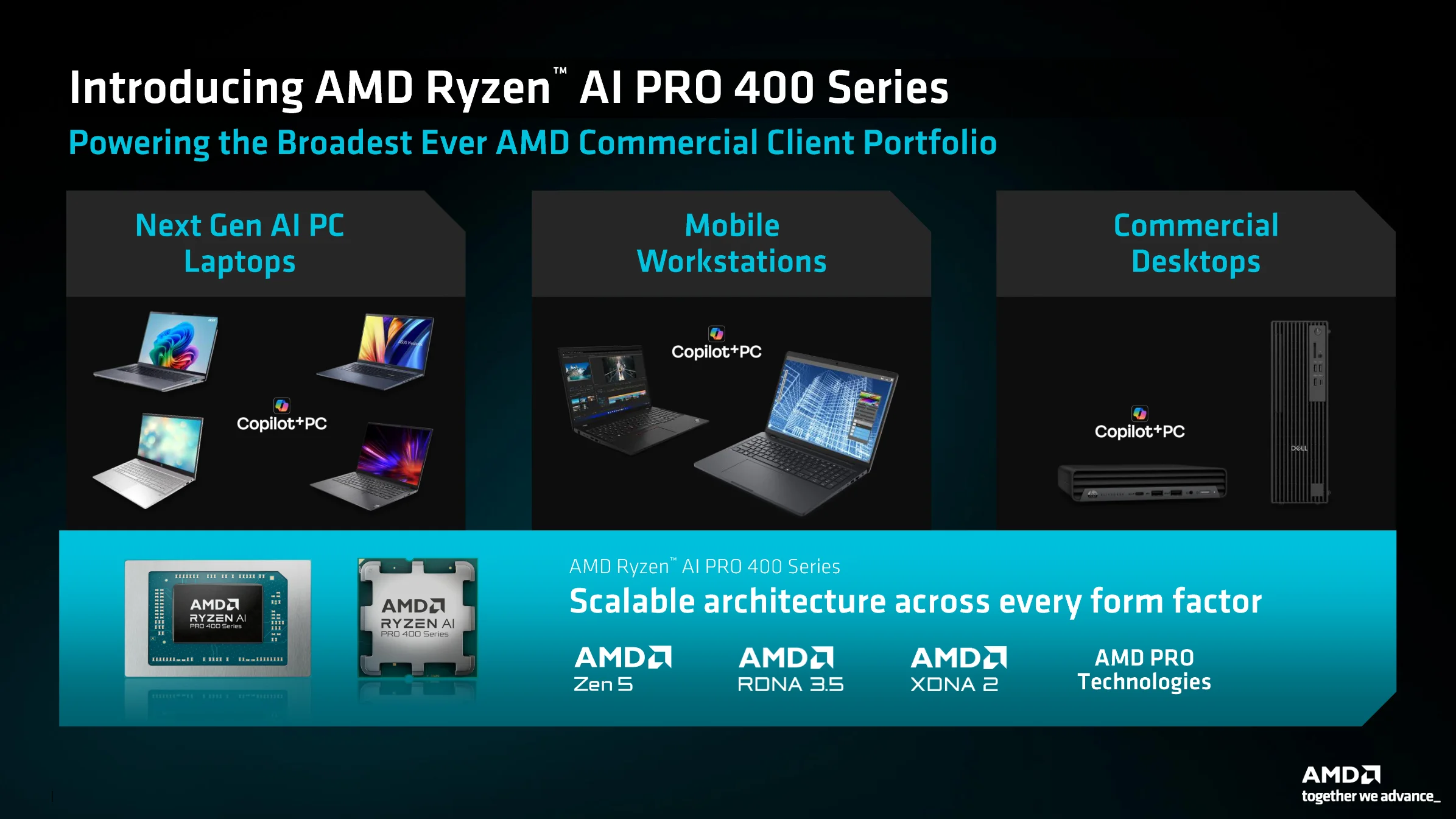
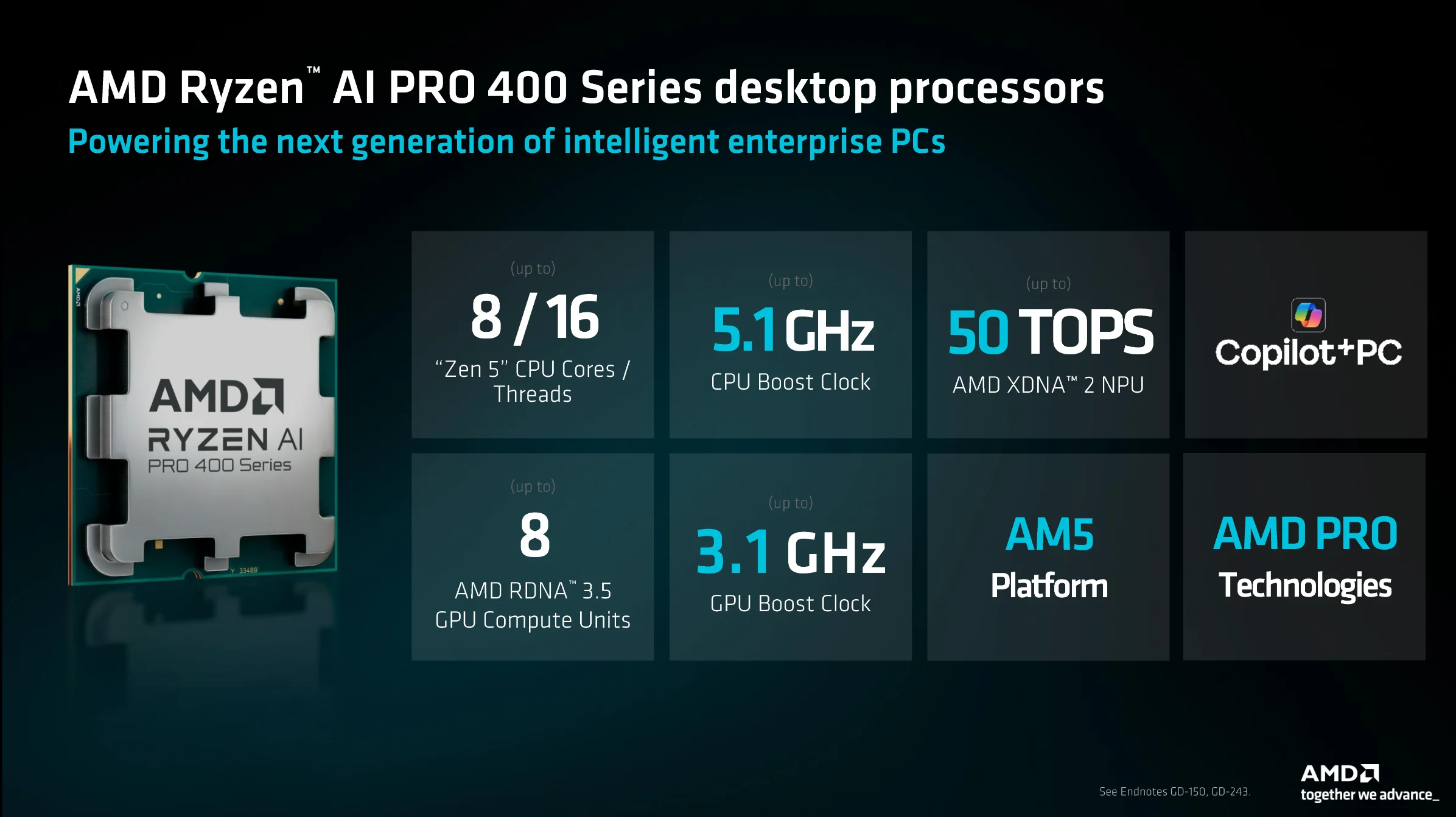
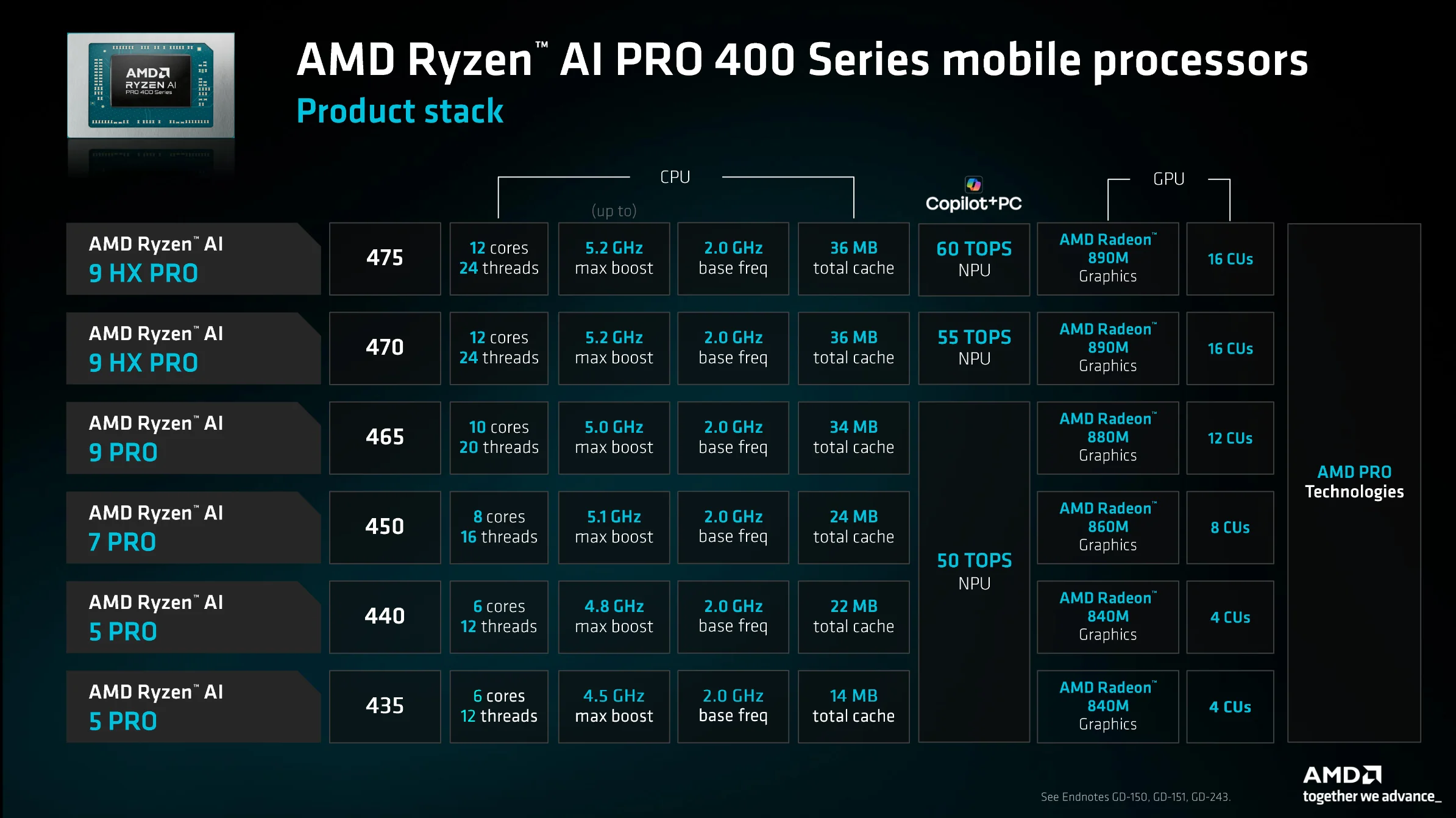
Although the silicon is identical, AMD is only pushing out the bottom rung of its Gorgon Point lineup on desktop right now. On mobile, AMD climbs up to the Ryzen AI 9 HX 475, which features a 60 TOPS NPU, Radeon 890M graphics with 16 RDNA 3.5 CUs, and 12 cores that can boost up to 5.2 GHz.

AMD hasn’t made any performance claims about the desktop chips yet, which isn’t surprising given this is a new category of product for Team Red. Given that the thermal design is similar and the silicon is nearly identical, we expect to see slightly higher overall performance from the Ryzen AI 400 desktop offerings compared to their mobile counterparts. As we’ve seen with consumer chips like the Ryzen 7 9700X and Ryzen 5 9600X, Zen 5 is fairly efficient around 65W, with the optional 105W TDP mode offering only slightly higher performance for nearly double the power.

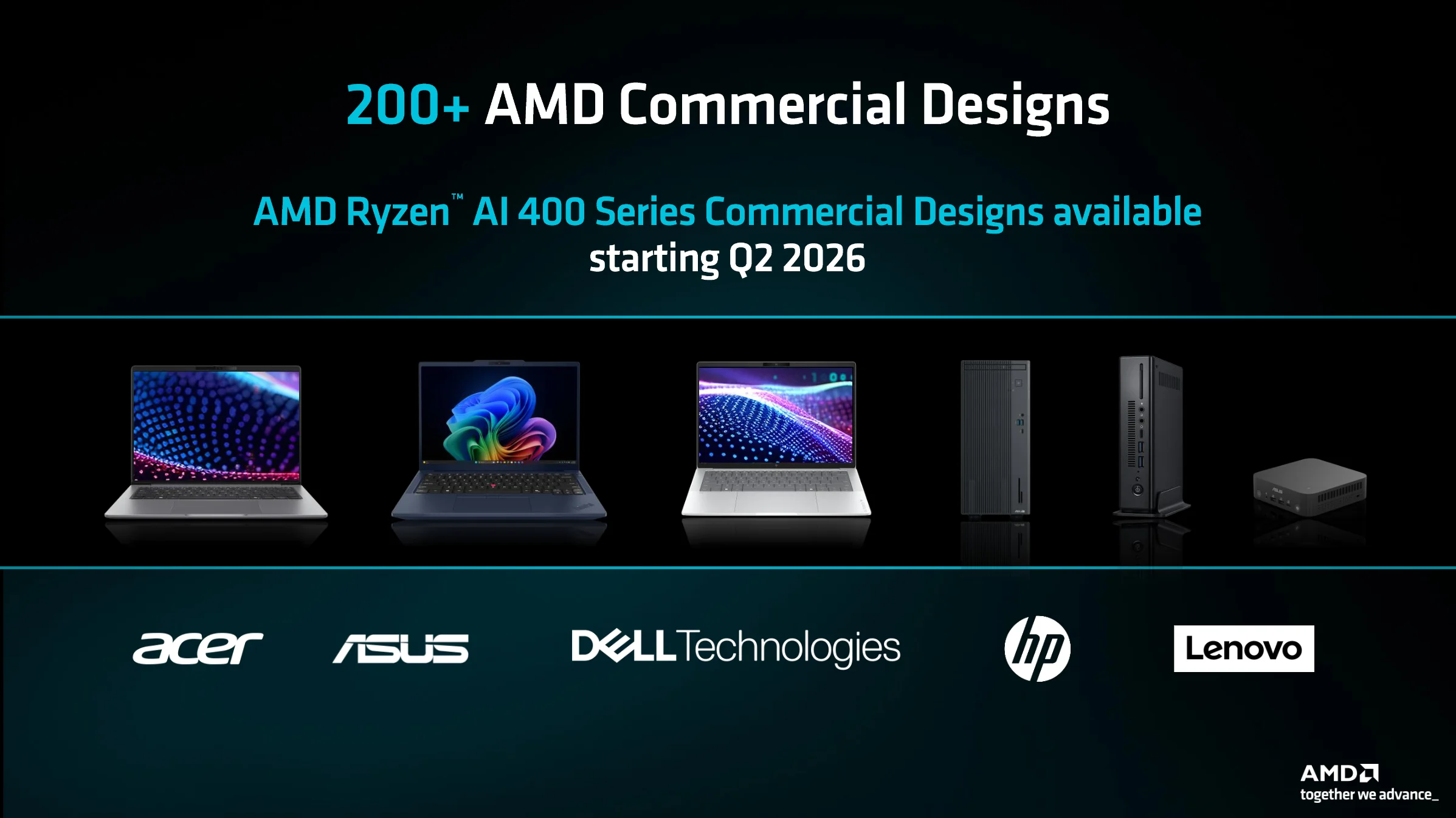
AMD will only offer these APUs in OEM systems for now. They come with Copilot+ certification, which calls for more than just an NPU. Critically, Copilot+ calls for at least 16GB of system memory, which is a variable AMD can’t control with boxed retail units. For now, AMD says commercial designs with these chips will be available in Q2 2026.
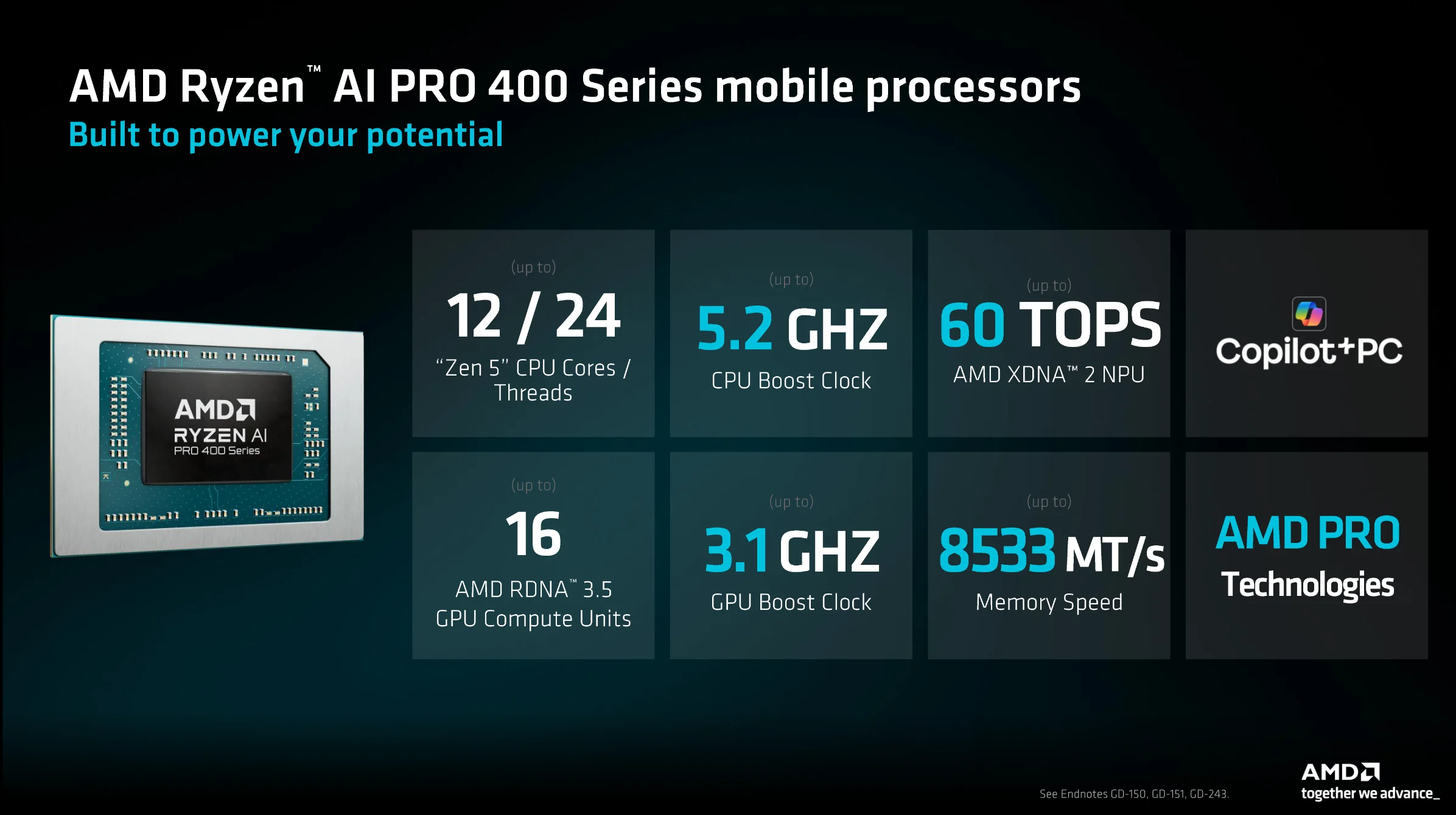
In total, AMD says it will have over 200 commercial designs available with its PRO chips, but that includes mobile offerings as well. Some of the OEMs AMD is working with include Acer, Asus, Dell, HP, and Lenovo. As you can see in the slide above, AMD is featuring smaller desktop designs, which is likely where we’ll see Ryzen AI 400 desktop chips in action.

Swipe to scroll horizontally
Header Cell - Column 0

Cores / Threads

Frequency (Base / Boost)

Cache (L2 + L3)

NPU TOPS

Graphics (CUs)

Ryzen AI 9 HX PRO 475

12 / 24

2 GHz / 5.2 GHz

36MB

60

Radeon 890M (16 CUs)

Ryzen AI 9 HX PRO 470

12 / 24

2 GHz / 5.2 GHz

36MB

55

Radeon 890M (16 CUs)

Ryzen AI 9 PRO 465

10 /20

2 GHz / 5 GHz

34MB

50

Radeon 880M (12 CUs)

Ryzen AI 7 PRO 450

8 / 16

2 GHz / 5.1 GHz

24MB

50

Radeon 860M (8 CUs)

Ryzen AI 5 PRO 440

6 / 12

2 GHz / 4.8 GHz

22MB

50

Radeon 840M (4 CUs)

Ryzen AI 5 PRO 435

6 / 12

2 GHz / 4.5 GHz

14MB

50

Radeon 840M (4 CUs)

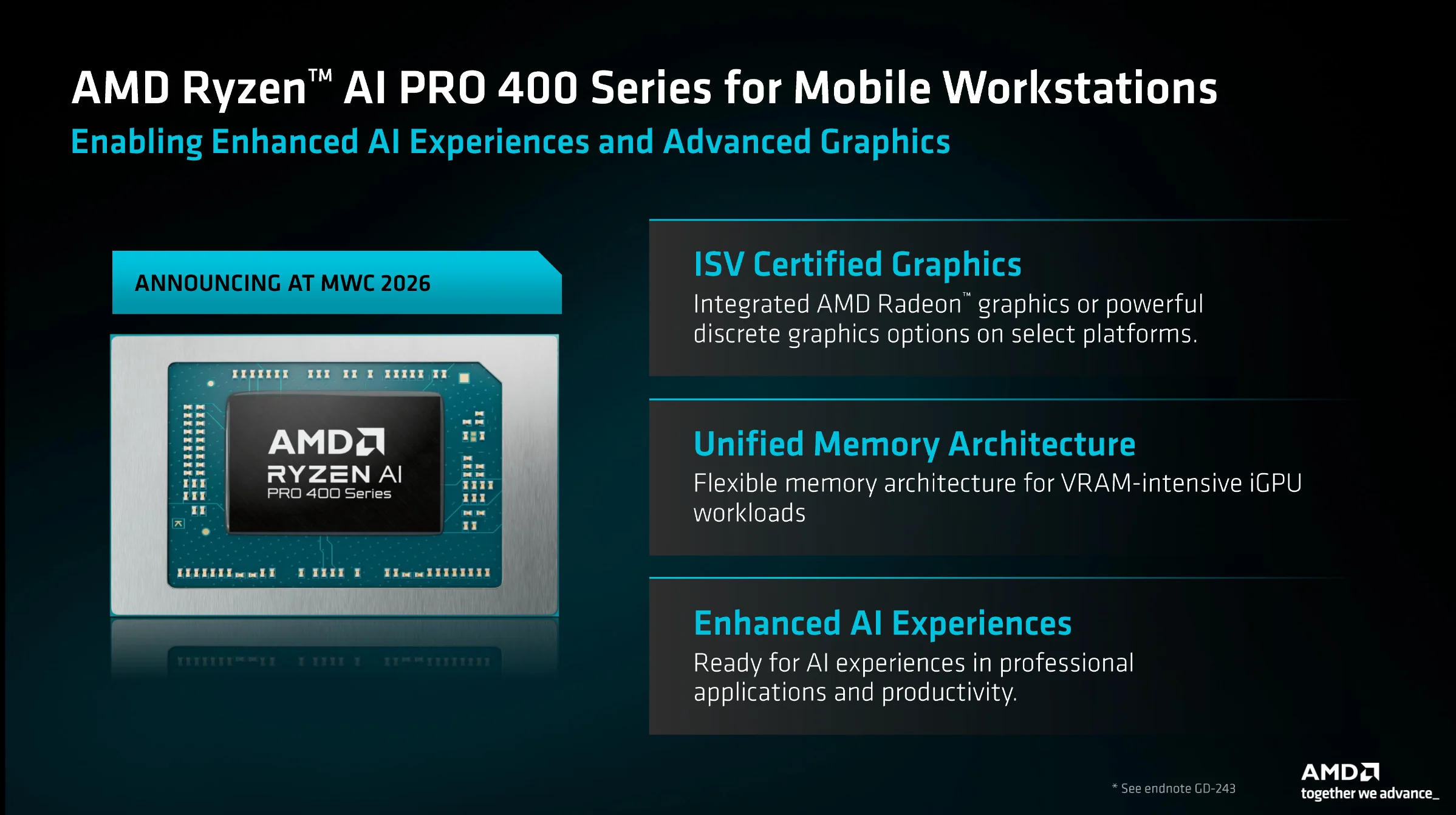
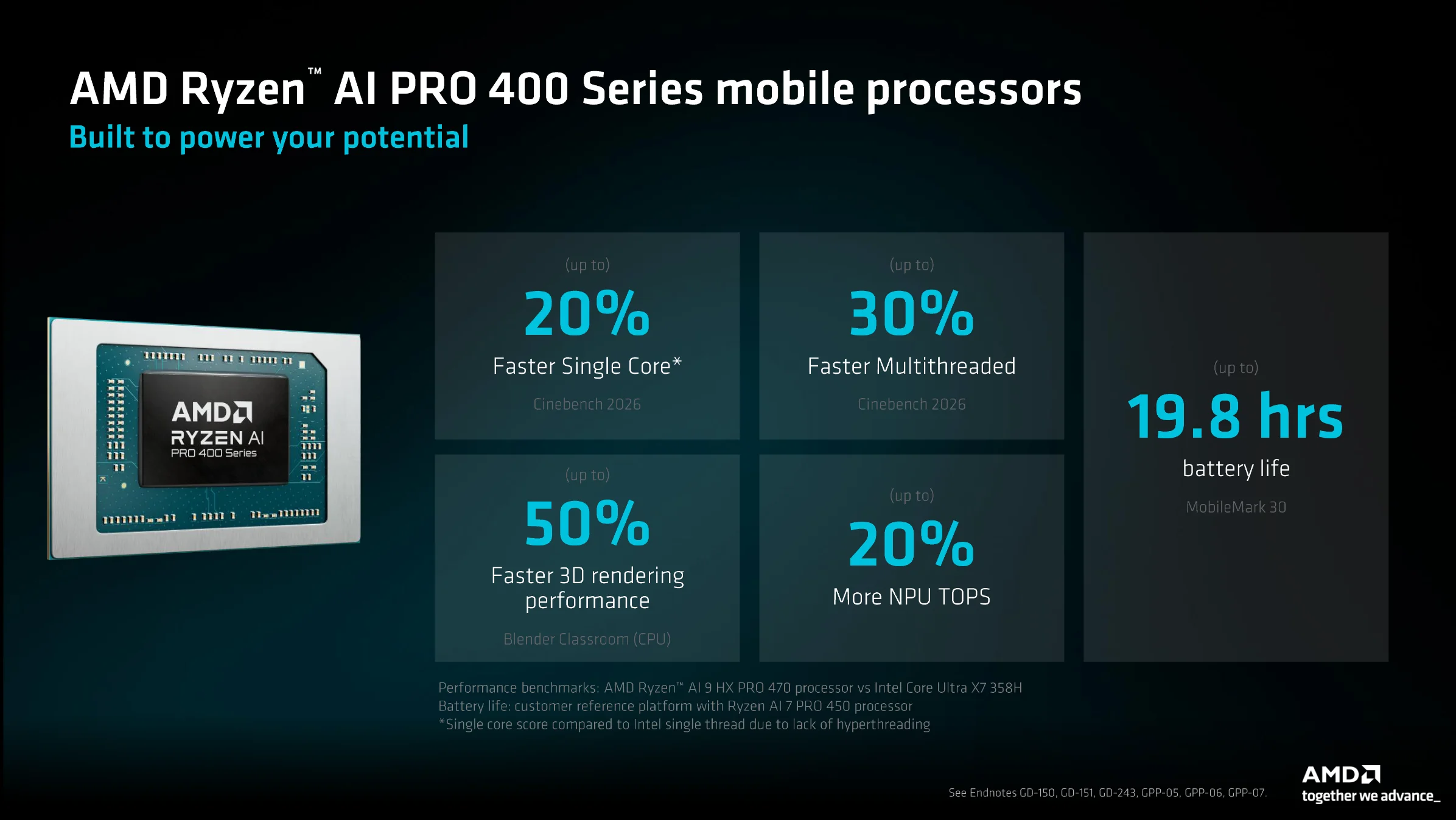
In addition to desktop offerings, AMD is introducing its Ryzen AI PRO 400 series for mobile, which mirrors the consumer lineup in the product naming and specs, as you can see in the table above. With both the mobile and desktop offerings, the PRO validation is what sets these chips apart from AMD’s consumer lineup. AMD includes additional features, like a multi-layer security ecosystem and manageability for IT administrators.

We should see designs with these CPUs roll out shortly. We’ve asked AMD if we can expect the lineup to expand up to AMD’s 12-core Gorgon Point design that we see on mobile. We’ve also asked about the fate of the long-rumored Ryzen 9000G APU lineup, though we don’t expect much news on that front at this time.

Google Preferred Source

Follow Tom's Hardware on Google News, or add us as a preferred source, to get our latest news, analysis, & reviews in your feeds.

TOPICS
Jake Roach
Senior Analyst, CPUs

Jake Roach is the Senior CPU Analyst at Tom’s Hardware, writing reviews, news, and features about the latest consumer and workstation processors.

  • thestryker
    Not that the APUs are ever really a great choice for desktop users since they have cut down cache not even matching the 8700G with any SKUs is a choice.
    Reply
  • Notton
    I don't even know what AMD is attempting with their desktop APU lineup.

    8CU on a R7? What happened to the 12CU config of the 8700G?
    If this 8CU were RDNA4.0, then it might have made sense, but it's RDNA3.5 from Jan-2023.

    Why would you even buy a 4CU config when the regular CPU lineup already has 2CU and both are fairly worthless when it comes to gaming?
    Reply
  • democog
    Good and all, but AMD should really reconsider their marketing.. I mean they, obviously, have great GPUs but the market share is abysmal.. why?

    Obviously, most people with NVidia cards are gamers, maybe they do not even know what CUDA is.. so all that leaves us with AMD's failed marketing: the naming of their GPU drivers or AI accelerators is so "offensive", akin to medical emergencies, that when people, even going close to one of their GPUs, will raise ..blood pressure to unprecedented levels :)
    Reply
  • cyrusfox
    Anemic offering. Although perfect for business machines or terminals. Not of much interested to the enthusiast, and this is a very competitive market going against Intel. The whole AI angle has yet to take off. No need for a dedicated NPU/TOPS. CPU and GPU more than capable. Who is calling for NPU on a desktop with minimum TOPS capability outside Microsoft?
    Reply
  • gggplaya
    Keep in mind that most Ryzen 7000 and 9000 CPU's already have an iGPU in the I/O die with 2CU. Perfectly fine for office and student work.

    I think AMD missed the mark here. If buying an APU, people want 8 core/ 16threads and the full 890M 16CU GPU. The 860m is not enough.

    It's like the normal CPU's with 2CU are your Toyota Corollas and they're fine for what they do. Then they release this sexy sportscar with a good chassis, but only give it a 150hp engine. That's what this CPU with an 860M is and no one really wants it.
    Reply
  • timsSOFTWARE
    What I would like to see in "AI" chips/systems is the fastest they can give us in terms of AI TOPS, and configurations starting at 128GB and going up from there to 1TB+ of RAM. Labeling something that can't run any of the models most people would like to run as "AI" makes it nothing more than a marketing gimmick.
    Reply
  • russell_john
    Windows 12 will require a CPU with a NPU built in. That's not a prediction, that is a spoiler ........ And AI Slop will no longer be optional but a hard requirement and impossible to turn off.
    Reply
  • russell_john
    timsSOFTWARE said:
    What I would like to see in "AI" chips/systems is the fastest they can give us in terms of AI TOPS, and configurations starting at 128GB and going up from there to 1TB+ of RAM. Labeling something that can't run any of the models most people would like to run as "AI" makes it nothing more than a marketing gimmick.

    The NPU isn't for LLMs, it's for Windows' AI Slop ...... Co-Pilot will be a hard requirement in Windows 12 and Co-Pilot needs a dedicated NPU to work properly.
    Reply
  • vossile
    As a tech person the view tends to be biased towards tech and all I know about tech. The marketing is likely smart for everyday people who are not CPU/GPU savvy or feel that 50TOPS NPU just doesn't cut it.
    Microsoft calls for Copilot, AMD has something to offer.
    CPU/GPU computing has hit the commodity wall and these "AI Chips" are the harbinger of what the next gen will look like.
    Interestingly, the RAM shortage is likely to make companies thing about modularising their setups again - hopefully finally all the way across the system. Here's me hoping that we'lll get some sort of RAM upgradability in graphics cards and AI-memory (as a 3rd/4th type of memory). That would be nice. Much like the SCSI-Cache cards of the 90s.
    Reply
  • Hotrod2go
    8700G users have no reason to update. ;)
    Reply

Comments

Please sign in to comment.
Rampagefang Market Intelligence