The US Navy has canceled the Constellation-class frigate program and will only complete two ships already under construction.
Before the cancellation, the frigate program was delayed by 36 months, with the first construction to be completed in 2029. Then the new frigates were to undergo extensive testing, probably delaying the frigate’s entry to the fleet for another 3 to 5 years, or between 2032 and 2034.
The Constellation-class frigate was supposed to replace the incredibly useless Littoral Combat Ship, the first “street fighter” as a Navy admiral once called it, that was built almost without weapons except for a Swedish 57mm gun with a limited range. The LCS was “envisioned to be a networked, agile, stealthy surface combatant capable of defeating anti-access and asymmetric threats in the littorals“
The Navy’s own “experts” concluded that the LCS would not survive in combat, but even so the Navy still has 25 of them (11 Freedom Class and 14 Independence Class), though it has scrapped 7. Each LCS with mission packages costs around $500 million, with annual operating cost for each LCS $70 million.
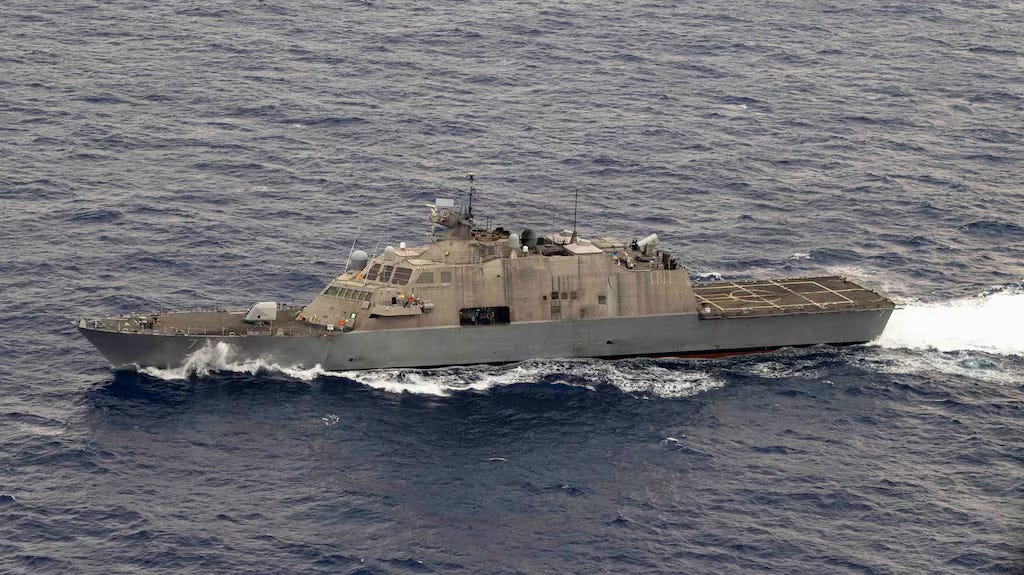 The Freedom-class littoral combat ship Detroit sails through the Caribbean Sea. Detroit had suffered a casualty to its propulsion system and needed to return to port in Florida for repairs. Photo: MC2 Anderson Branch / US Navy
The Navy could save a bundle of money and personnel by dumping all the LCS ships.
Latest stories

Leaked wedding video reveals hypocrisy in Islamist Iran’s elite

Australia’s bow to Trump’s America is past its use-by date

The rot eating at China’s war machine
The Constellation class frigate was supposed to be a replacement for older frigates and would deploy the AEGIS missile defense system and a suite of anti-submarine sensors. It was supposed to be speedy enough to keep pace with US Carrier task force operations. Unfortunately the shipbuilding effort started well before the design was complete.
Originally intending a quick fix by adopting an existing and successful Italian frigate design (called FREMM), the navy made so many changes that the still-unfinished design was only about 15% common to the original. At the time of the cancellation, the power plant for the ship was unfinished and untested, a serious mistake considering power plant failures in the LCS program and in British aircraft carriers.
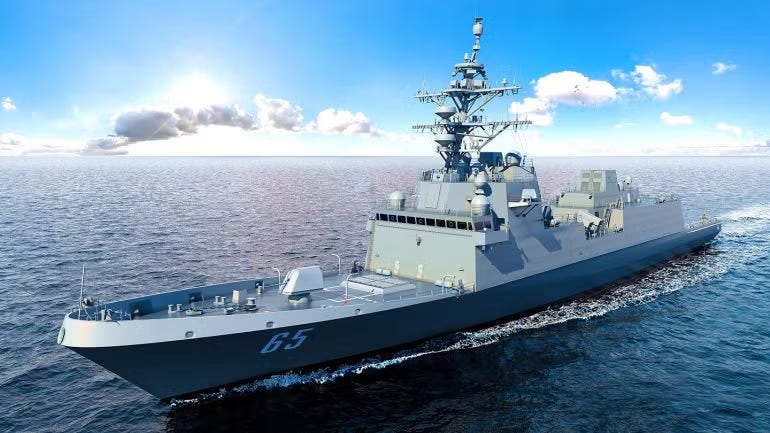 The US Navy was planning for the build of 20 Constellation-class guided-missile frigates. Photo: US DoD
In the meantime, while the Navy was failing at shipbuilding and ship design, wasting tens of billions of dollars, it was proceeding on decommissioning its Ticonderoga class cruisers. It has already decommissioned 15 cruisers, scrapped five (the others are sitting in the Reserve Fleet – in other words, mothballed) and there are six more in the queue for decommissioning.
Having built 27 Ticonderoga class cruisers between 1983-1994, the navy spent approximately $3.7 billion to modernize seven cruisers with the goal of extending their service life.
Four of the modernized cruisers (USS Vicksburg, USS Cowpens, USS Leyte Gulf, and USS Antietam) were decommissioned before they could be put back into service, representing a loss of about $1.84 billion in funds. A recent navy decision determined that three cruisers (USS Gettysburg, USS Chosin, and USS Cape St. George) would have their service lives extended to 2029 after completing their modernization upgrades, anticipating the arrival of the Constellation frigates (now canceled).
The Ticonderogas support the AEGIS air defense system including two MK-41 vertical launch systems (supporting up to 122 missiles) that can fire standard air defense missiles (SM-2, SM-3, SM-6), Tomahawk cruise missiles and ASROC, anti-submarine rockets. The cruisers also mount the Evolved Sea Sparrow missile, two five inch guns and two Phalanx rapid-fire, self-contained gun systems plus Harpoon anti-ship missiles and Mark 3 torpedoes.

Sign up for one of our free newsletters
- The Daily Report Start your day right with Asia Times' top stories
- AT Weekly Report A weekly roundup of Asia Times' most-read stories
Instead of wasting billions on failed ships that will never support US carrier-based fleets, it is legitimate to ask why the Ticonderogas are being rapidly taken out of service at a time when they are sorely needed. There are at least four upgraded Ticonderogas that could be put back into service fairly quickly and at low cost. Others may also be seaworthy enough to be rebuilt and recommissioned.
The Navy’s answer is it wants more Arleigh Burke destroyers in the fleet. It plans to build 12 new ones at a cost of $2.5 billion each (not counting weapons). US shipyards can build two of these per year, meaning that by 2029 potentially six new ships will be completed.
The Navy could task its shipyards to bring the Ticonderogas back into service, augmenting the US surface fleet more rapidly than any other solution, while the Arleigh Burke program proceeds. Meanwhile, money saved by dumping off the combat-unsurvivable LCS could help pay for resuscitating Ticonderoga cruisers.
Former US Deputy Undersecretary of Defense Stephen Bryen is a senior Asia Times correspondent. This article first appeared on his Substack newsletter Weapons and Strategy. It is republished with permission.
Sign up here to comment on Asia Times stories
Sign in with Google Or Sign up Sign in to an existing account
Thank you for registering!
An account was already registered with this email. Please check your inbox for an authentication link.