BTC 72,807.00 +6.62%
ETH 2,134.55 +7.66%
S&P 500 6,869.50 +0.78%
Dow Jones 48,739.41 +0.49%
Nasdaq 22,807.48 +1.29%
VIX 21.15 -10.27%
EUR/USD 1.09 +0.15%
USD/JPY 149.50 -0.05%
Gold 5,151.60 +0.33%
Oil (WTI) 76.11 +1.94%
BTC 72,807.00 +6.62%
ETH 2,134.55 +7.66%
S&P 500 6,869.50 +0.78%
Dow Jones 48,739.41 +0.49%
Nasdaq 22,807.48 +1.29%
VIX 21.15 -10.27%
EUR/USD 1.09 +0.15%
USD/JPY 149.50 -0.05%
Gold 5,151.60 +0.33%
Oil (WTI) 76.11 +1.94%

Enthusiast runs desktop PC off 56 AA batteries — Intel computer lasts less than 5 minutes while playing Minesweeper

| 2 Min Read
YouTube creator ScuffedBits experimented with a desktop PC and AA batteries just to see how many they needed to run and for how long will a desktop PC last on AA battery power alone.

Enthusiast runs desktop PC off 56 AA batteries — Intel computer lasts less than 5 minutes while playing Minesweeper

56 AA batteries powering an old desktop PC
(Image credit: ScuffedBits/YouTube)

Gaming laptops come with power-dense Lithium-based batteries to give you on-battery gaming for a few hours — but what would happen if you ditched these specialized power cells and instead chose garden-variety AA batteries to run your desktop gaming PC?
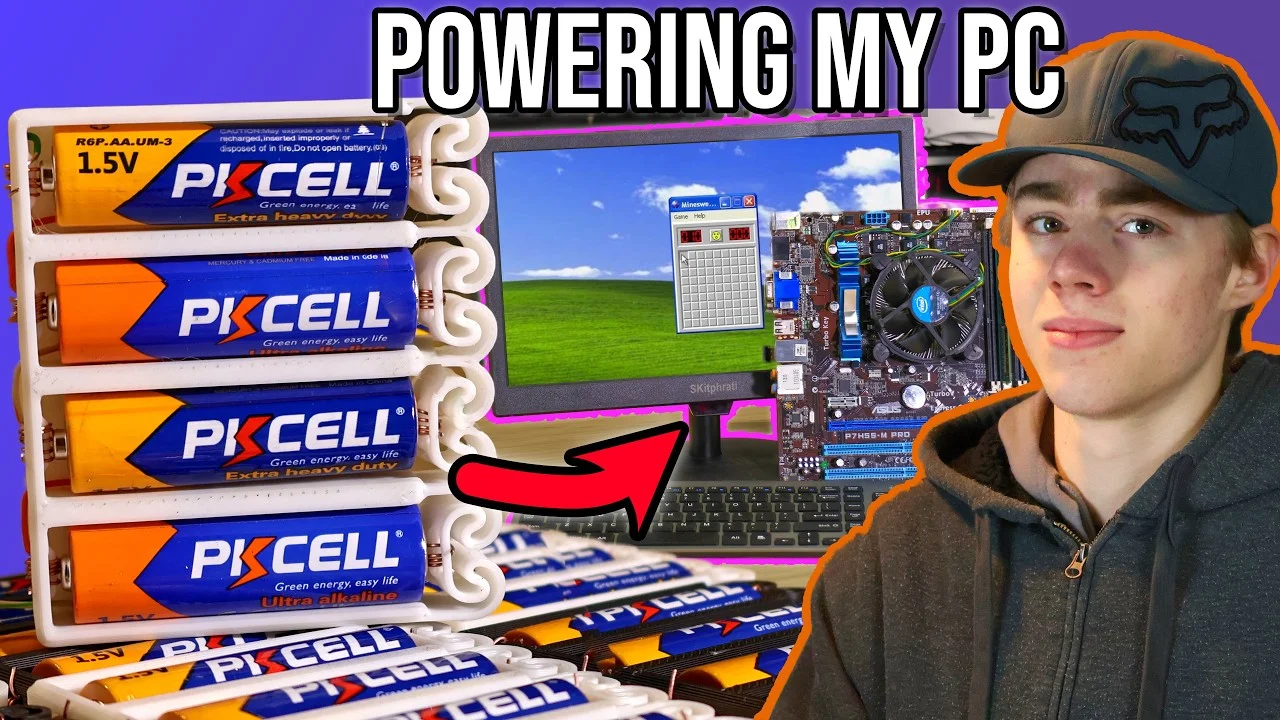
This is exactly what YouTube creator ScuffedBits decided to find out when he pulled out the old 450-watt CX430 power supply and replaced it with an ATX power supply plug from AliExpress that lets you connect its 12V cables to practically anywhere you like. Unfortunately, the creator did not share the specifications of their PC, but it seemed to have an entry-level Intel CPU chip, two RAM sticks, and a 2.5-inch SATA SSD running on Windows 10. They also said that they’ll try running a GPU on the system later.

Now, AA batteries are just 1.5 volts, so you need to connect 8 cells in series to hit the required 12 volts. However, we seriously doubt you can run an x86 system with that small a number of batteries. The motherboard’s status did LCD light up when he attached the batteries to the power cable, but when he measured the power draw from the AAs, he measured a measly 0.06 amps. He powered up the system, and the fan spun for a second before nothing happened.

In an attempt to achieve their goal, ScuffedBits added two more 8-battery packs in parallel, but the computer just refused to boot.
How Many AA Batteries Does it Take to Power A PC Setup? - YouTube How Many AA Batteries Does it Take to Power A PC Setup? - YouTube
Watch On

In an attempt to solve the problem, they switched from carbon to alkaline batteries, which can output a higher current and last longer. However, ScuffedBits still ran into the same problem: the system would turn on for only a couple of seconds before dying again.

Wiring tweaks, mains booting, and more

They figured out that the issue was with the thin wires they were using to connect the batteries, which cannot handle the voltage spikes that the PC demands when turned on. To address that issue, they added two big capacitors for some power buffers, used multiple wires to ensure that multiple cables carried power for the entire system, and are now running the entire thing off 56 alkaline batteries. They also kind of cheated by using an external power supply to boot the PC, and then would only switch over to the AA system once the game was running.

With the setup ready, ScuffedBits switched over from the power supply to the AA batteries, and the PC actually ran on battery power alone. However, it seems that launching Steam requires too much power, causing the PC to shut off after just 52 seconds. So, they decided to have A Short Hike running on their next try, which is a rather modest game when it comes to its system requirements. Still, the computer only lasted for five seconds before flat-out dying. But because they were adamant on completing at least one round running purely on batteries, they decided to lower the bar even further and just tried to defeat Minesweeper on easy.

ScuffedBits was eventually able to successfully do this, finishing one round on easy in 4 minutes and 35 seconds, with the PC’s batteries running out at the same time — but that wasn’t enough. They wanted to completely beat the game on AA power alone, so they replaced their LED monitor’s power supply with eight rechargeable AA batteries. They didn’t have to replace their wireless mouse and keyboard, though, as they were already running on AAs. This time, the PC only lasted for 2 minutes and 14 seconds, probably because they didn’t use fresh batteries.

They seemed happy with the results of their experiment, but, for one last attempt, they decided to install a GPU and run the game at full screen. They switched over to battery power alone, and, to their surprise, the “gaming” desktop PC actually ran for around nine seconds.

This fun and wacky experiment just showed how far battery technology has moved forward, allowing us to get relatively good gaming performance even on small handhelds. A few commenters suggested that the YouTuber try again, but to use laptop components designed for low power draws this time around. I would actually be interested to see how many batteries you need to run one of the highly-efficient Snapdragon laptops or an Apple silicon device.

Google Preferred Source

Follow Tom's Hardware on Google News, or add us as a preferred source, to get our latest news, analysis, & reviews in your feeds.

TOPICS
Jowi Morales
Contributing Writer

Jowi Morales is a tech enthusiast with years of experience working in the industry. He’s been writing with several tech publications since 2021, where he’s been interested in tech hardware and consumer electronics.

  • Notton
    What he needs is a Battery Management System.

    You'd think that 1.5V \00d7 8 = 12V, but that only happens when there is zero load.
    Once a load is applied, that 1.5V quickly droops to around 1.2V, and you now have a 9.6V power line.

    A BMS will adjust the output voltage so it's a constant 12V, even if the input fluctuates.

    That and don't use AA cell Carbon, or Alkaline batteries for high sustained loads like this.
    Use C or D cell NiMH, or AGM (Lead Acid), assuming they don't want to use Lithium of any sort.

    Lastly, is this really "enthusiast" stuff?
    To me, it's more like experimenting with an electrical hobby.
    Reply
  • Roland Of Gilead
    Notton said:
    it's more like experimenting with an electrical hobby.
    That's sounds like 'enthusiast' to me! Different horses for different courses, I guess.
    Reply
  • Dementoss
    Notton said:
    What he needs is a Battery Management System.
    No, what he needs is to not waste so many batteries.
    Reply
  • USAFRet
    Dementoss said:
    No, what he needs is to not waste so many batteries.
    We've had many people here wanting to use desktop level parts to build a "laptop".

    The answer always came back in that you'd need a car battery size thing to run more than a couple of minutes.
    This just proves it.
    Reply
  • Gururu
    Notton said:
    Lastly, is this really "enthusiast" stuff?
    To me, it's more like experimenting with an electrical hobby.
    What he does defines enthusiast perfectly. You can't buy your way to be an enthusiast, you just need to apply yourself.
    Reply
  • ezst036
    USAFRet said:
    We've had many people here wanting to use desktop level parts to build a "laptop".

    The answer always came back in that you'd need a car battery size thing to run more than a couple of minutes.
    This just proves it.
    This is basically a non-sequitor.

    All you would battery-wise need is an "ATX battery" - a form factor for lithium ions. Something which does not currently exist.

    Laptops would also need their own ATX form factor spec. An LTX so to say, along with a standardized and agreed upon spec for the video/power connectors and a few other things that round out this sort of specification.

    The ATX form factor is not just about motherboard shape, its also about the connectors. power supply, and the case/housing. All the things missing from the laptop context.
    Reply
  • USAFRet
    ezst036 said:
    This is basically a non-sequitor.

    All you would need is an "ATX battery" - a form factor for lithium ions. Something which does not currently exist. I mean this just in the context of the battery itself.

    Laptops would also need their own ATX form factor spec. An LTX so to say, along with a standardized and agreed upon spec for the video/power connectors and a few other things that round out this sort of specification.

    The ATX form factor is not just about motherboard shape, its also about the connectors and power supply. All the things missing from the laptop context.
    Capacity.
    Sure, you can get a desktop system to run on batteries.

    I have a 12v jump starter for the car. I also have a 12v-110v inverter. I could easily plug a PC into that and get it to boot up.

    The question is...for how long?
    This construct seems to sort of answer the question.
    Reply
  • DavidC1
    Notton said:
    A BMS will adjust the output voltage so it's a constant 12V, even if the input fluctuates.
    That's not what a BMS does.
    Reply
  • raulongo
    Game Gear: "First time?"
    Reply
  • Notton
    DavidC1 said:
    That's not what a BMS does.
    Yeah, I forgot the exact name for it.
    That thingamajig that regulates output voltage so it doesn't droop too low or high doohickey and possibly has a circuit to protect batteries from being over discharged.
    Reply

Comments

Please sign in to comment.
Rampagefang Market Intelligence