AWS backs Open VSX as Rust survey shows VS Code decline

AWS backs Open VSX as Rust survey shows VS Code decline
AI-first editors and agent-driven tooling intensify competition in the IDE market

The Open VSX registry, used for installing extensions in editors compatible with Visual Studio Code (VS Code), will run on Amazon Web Services (AWS) infrastructure in Europe as part of a "strategic investment" from the cloud giant.
Open VSX is operated by the Eclipse Foundation, and provides extensions unencumbered by the restriction Microsoft places on the VS Code marketplace that "alternative products including those built on a fork of the Code-OSS Repository, are not permitted to access the Visual Studio Marketplace." Microsoft cites security and compatibility as reasons, and there is no business case to "run a full-scale global service for everyone to use," in the words of Chris Dias, who was head of product for VS Code at the time.
The Open VSX project was started by GitPod (now Ona) in early 2020 as a vendor-neutral registry for use by Code-OSS forks, including VSCodium and Theia. The number of such forks has increased as AI usage has grown, and now includes Google Antigravity, Cursor, Windsurf, and AWS Kiro. The problem with Open VSX is that it has many fewer extensions than the VS Code marketplace, though the more popular choices are likely to be present other than those from Microsoft itself.
In early 2023, Eclipse community manager John Kellerman appealed for funding, stating that "we will be forced to decommission the Open VSX registry by the end of May." Funding was forthcoming in the shape of a new working group formed from interested companies, and today the registry appears to be on a firm footing, with over 300 million monthly downloads and new sponsorship from AWS and Cursor.
Last week, the project described plans to transition to a hybrid infrastructure with a primary AWS deployment in Europe and a secondary on-premises environment in Canada. There will be a dedicated fallback storage cluster.
There is also work in progress on a new verification framework, which will attempt to block malicious and/or impersonated extensions.
Perhaps less welcome is that Open VSX is no longer free for all users. In January, the project introduced usage tiers, with subscriptions required for organizations generating more than 75 requests per second.
- Generic methods arrive in Golang, but they weren't the top dev demand
- Rapid AI-driven development makes security unattainable, warns Veracode
- Cloudflare experiment ports most of Next.js API 'in one week' with AI
- Go library maintainer brands GitHub's Dependabot a 'noise machine'
Microsoft's VS Code has long been the most popular IDE (integrated development environment), thanks to being free to use, cross-platform, and with hundreds of thousands of extensions – 93,862 at the time of writing. New feature releases appear every month. Last year's Stack Overflow survey put VS Code usage at 76.2 percent of professional developers, more than double the 29.7 percent for second-place Visual Studio.
Although that dominance is unlikely to end soon, there are signs that it may have peaked. The AI wave has stimulated competition, and companies such as OpenAI argue that traditional IDEs are sub-optimal for agent-driven development.
Microsoft has stuffed endless AI features into VS Code, but the drive to keep up has also alienated developers who find those features intrusive or distracting.
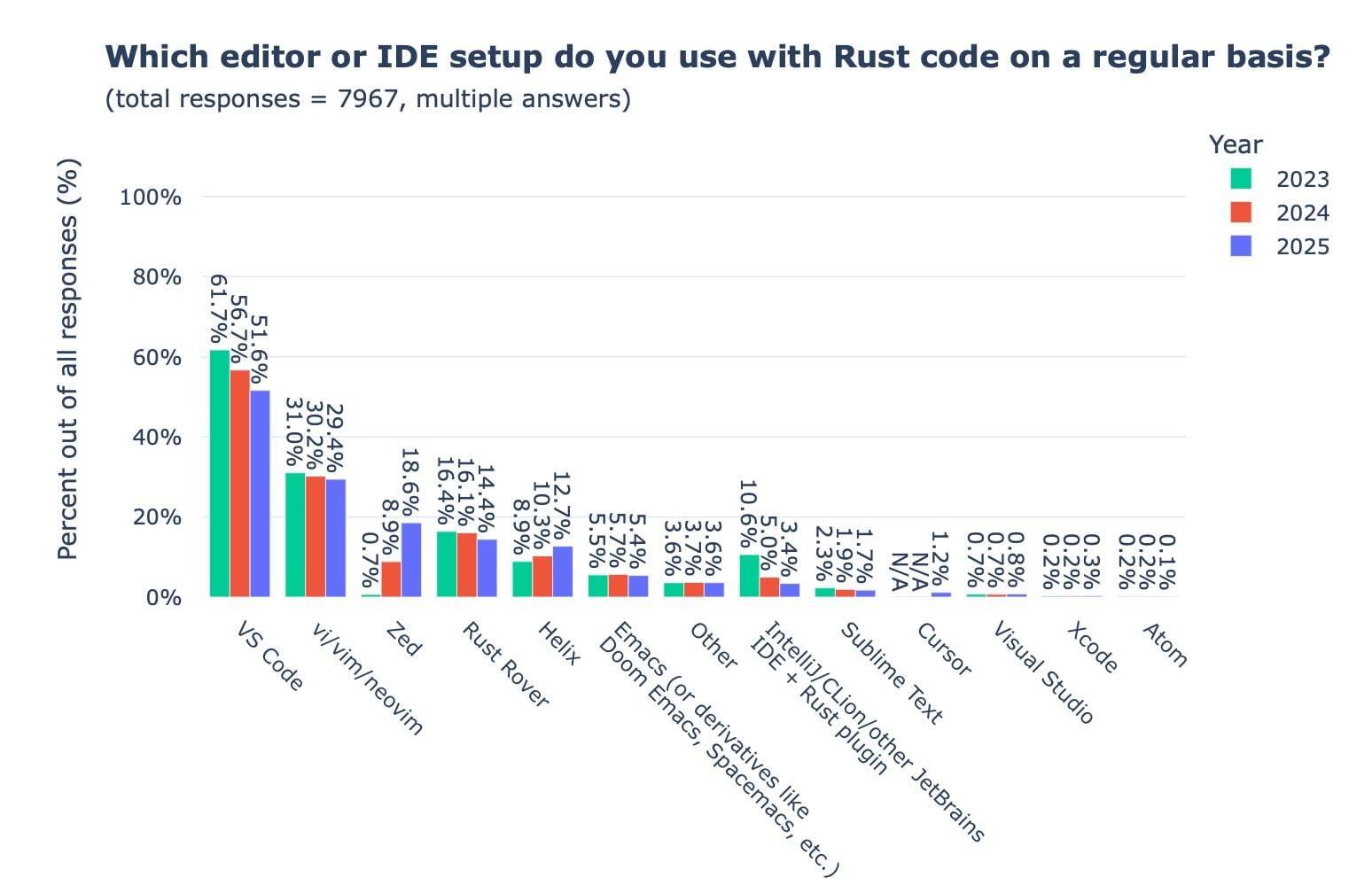
A new survey of Rust developers shows VS Code usage declining, with some devs switching to Zed
The results of the 2025 State of Rust survey have been published, showing that in this particular community VS Code usage has declined from 61.7 percent to 51.6 percent in three years. The Rust-powered Zed has grown from almost nothing to 18.6 percent usage now, while the dedicated Rust Rover IDE from JetBrains has seen a slight decline, from 16.4 percent to 14.4 percent. ®
