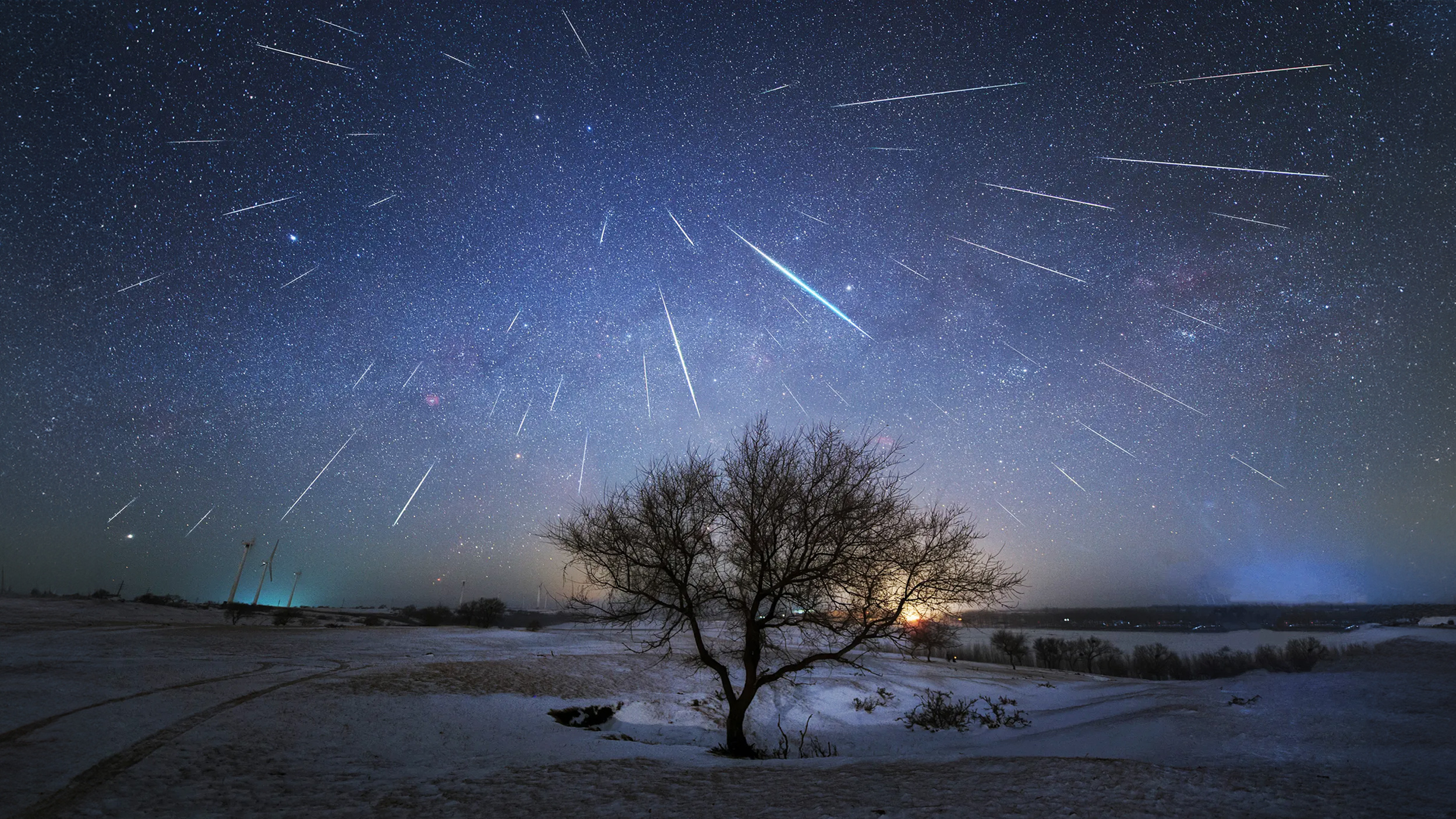
 If you can find clear skies and observe when the Moon isn't out, the Geminids could well put on the most spectacular show of any meteor shower of the entire year. Whereas the Moon has washed out many of the fainter Geminid meteors in past years, the time where you have a moonless sky on the night of December 13/morning of December 14 should make for an epic view of Geminid meteors: potentially the best of the year.
Stocktrek Images, Inc. / Alamy
Key Takeaways
If you can find clear skies and observe when the Moon isn't out, the Geminids could well put on the most spectacular show of any meteor shower of the entire year. Whereas the Moon has washed out many of the fainter Geminid meteors in past years, the time where you have a moonless sky on the night of December 13/morning of December 14 should make for an epic view of Geminid meteors: potentially the best of the year.
Stocktrek Images, Inc. / Alamy
Key Takeaways
- The night of December 13 and the pre-dawn hours of December 14 will deliver a spectacular show: the peak of the Geminid meteor shower.
- Arising not from a comet’s debris stream, but from an asteroid’s, the Geminids have been strengthening over time, and 2025’s show is predicted to produce 150 meteors-per-hour at its peak.
- With a waning Moon, the hours from 11 PM to 2 AM (just before moonrise) will provide the best viewing, giving December’s Geminids a chance to be 2025’s best show, and the greatest Geminid shower ever seen.
 Sign up for the Starts With a Bang newsletter
Travel the universe with Dr. Ethan Siegel as he answers the biggest questions of all.
Subscribe
Sign up for the Starts With a Bang newsletter
Travel the universe with Dr. Ethan Siegel as he answers the biggest questions of all.
Subscribe
Like clockwork, there are a series of celestial events and sights that reappear at the same time with each passing year. The Earth, revolving around the Sun in its orbit, not only sees the night sky’s constellations and deep-sky objects change along with its relative position to the Sun, but also encounters barely visible debris streams from volatile orbiting bodies — comets and asteroids — at predictable intervals throughout the year. The asteroids and comets orbit the Sun, heating up when they draw near, causing them to outgas, break apart, and emit particles. Those particles get stretched into the shape of the invisible ellipse that traces out their orbits, and when Earth passes through those ellipses, we get the same meteor showers year after year.
January’s Quadrantids, April’s Lyrids, August’s Perseids, October’s Orionids, and November’s Leonids are among the most famous recurrent meteor showers, with the Perseids having been hailed for centuries as Earth’s most reliable meteor shower. But in recent years, the story has changed, as a relatively new meteor shower now frequently outshines the Perseids in terms of the highest rates of meteors at its peak: December’s Geminids. This December, they peak on the night of December 13th and in the pre-dawn hours of December 14th, and many are expecting around 150 meteors-per-hour (or 2-to-3 meteors per minute) at that peak. Here’s what you need to know to enjoy this year’s show to the fullest.
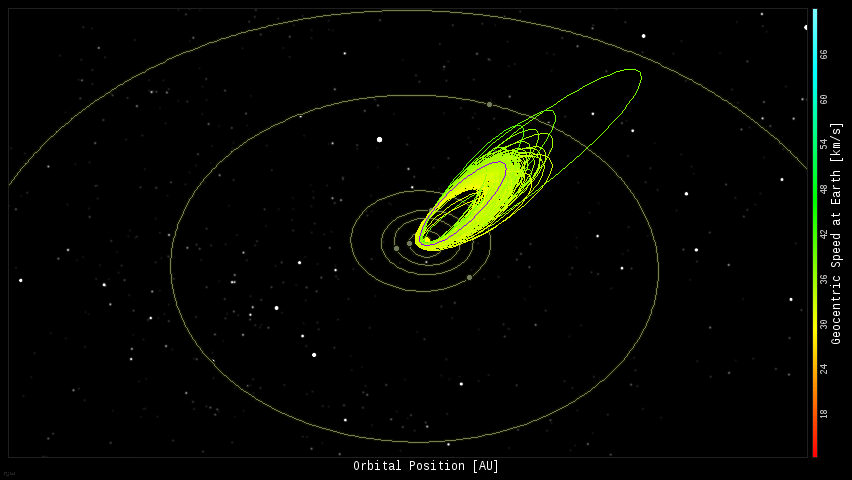 In 2012, a network of all-sky cameras not only tracked the streaks left by more than 300 Geminid meteors, but NASA scientists were able to reconstruct the orbits of those meteors, determining that every single one of them was consistent with originating from asteroid 3200 Phaethon: precisely as predicted by John Couch Adams’ theory linking meteor showers with a periodic parent body.
Credit: NASA
In 2012, a network of all-sky cameras not only tracked the streaks left by more than 300 Geminid meteors, but NASA scientists were able to reconstruct the orbits of those meteors, determining that every single one of them was consistent with originating from asteroid 3200 Phaethon: precisely as predicted by John Couch Adams’ theory linking meteor showers with a periodic parent body.
Credit: NASA
Whereas most meteor showers arise from comets — the volatile icy bodies populating our Kuiper belt that take a gravitational plunge into the inner Solar System — the Geminds are unusual for arising instead from an asteroid: 3200 Phaethon. Comets frequently have tails while asteroids almost never do, but it’s a long-repeated myth that the tails of these objects are what creates the meteor showers that we see on Earth. Instead, what happens is the following:
- As the object approaches near to the Sun, the combination of solar radiation, solar wind particles, and the Sun’s gravity causes the object to (even if slightly) fragment and break apart.
- The tiny pieces that become part of a tail are blown away, out of the Solar System, while the tiny pieces that aren’t part of either the dust or ion tail remain in the same orbit as the main parent nucleus, except are slightly either ahead of or behind the main body.
- Over time and many, many subsequent orbits, those co-orbiting fragments get stretched out to occupy the entire orbit of the main body, creating a debris stream.
- And finally, when Earth passes through that debris stream, which it does at the same relative location in its orbit year after year, those fragments create a meteor shower as they burn up in Earth’s atmosphere.
That’s the origin of meteor showers, as first proposed by John Couch Adams in the 1800s and verified with the linking of November’s Leonids with its parent body: Comet Tempel-Tuttle.
 This time lapse animated photograph shows asteroid 3200 Phaethon, tracked from Riga, Latvia, in 2017. This is the parent body of the Geminid meteor shower: an asteroid just 5.8 km in diameter, approximately the size of the asteroid that catastrophically struck Earth some 65 million years ago. The farther an object is from us, the more observations we need over long time periods to determine its future trajectory.
Credit: Ingvars Tomsons/Wikimedia Commons
This time lapse animated photograph shows asteroid 3200 Phaethon, tracked from Riga, Latvia, in 2017. This is the parent body of the Geminid meteor shower: an asteroid just 5.8 km in diameter, approximately the size of the asteroid that catastrophically struck Earth some 65 million years ago. The farther an object is from us, the more observations we need over long time periods to determine its future trajectory.
Credit: Ingvars Tomsons/Wikimedia Commons
For the Geminids, however, they aren’t created by a long-period comet, but rather by a short-period asteroid: 3200 Phaethon, as you can see above. This asteroid doesn’t exhibit a tail at all, and appears to be an extremely quiet body itself. It shows no signs of a coma, exhibits no visible or detectable debris coming off of it, and appears more like a single, solitary point of light to our telescopes and instruments that can observe it. There’s no observable outgassing, volatiles getting sublimated, or particles being emanated from this parent body, which likely means all of its ices were depleted long ago.
And yet, over the past 40-45 years, the Geminids — which result from the debris stream of asteroid 3200 Phaethon — have intensified significantly. Just a few decades ago, the peak of the Geminids maxed out at about 50 meteors-per-hour, or less than one meteor per minute. But over the past 10 years, the average peak of the Geminids has exceeded 120 meteors-per-hour, or more than double that earlier rate.
What’s the cause of this intensification?
It’s the slow, gradual destruction of the parent body itself. As it passes close to the Sun, asteroid 3200 Phaethon experiences tidal forces, which slowly tear pieces of the asteroid apart. This was originally a speculative and theoretical idea, but infrared observations of the parent bodies of meteor showers have confirmed it spectacularly. We can observe asteroids and comets fragmenting apart, creating small particles of debris that co-orbit with the parent body. Over time and many orbits, these particles stretch out and fill the parent body’s orbital path, ensuring that as Earth crosses it, a meteor shower ensues.
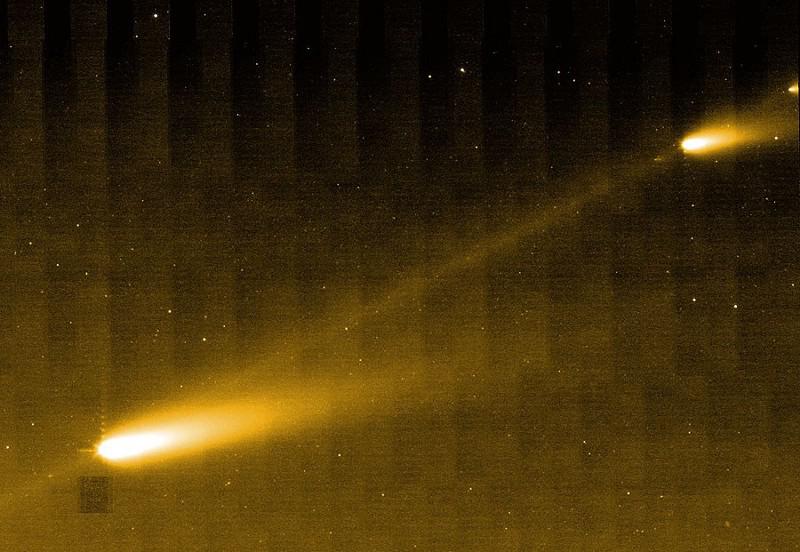 As they orbit the Sun, comets and asteroids typically break up over time, with debris between the chunks along the path of the orbit getting stretched out to create debris streams. These streams cause meteor showers when the Earth passes through that debris stream: with younger showers having more concentrated debris streams around the parent body’s nucleus and older showers having a more uniform debris stream. This image taken by Spitzer along a comet’s path shows small fragments outgassing, but also shows the main debris stream that gives rise to the meteor showers that occur in our Solar System.
Credit: NASA/JPL-Caltech/W. Reach (SSC/Caltech)
As they orbit the Sun, comets and asteroids typically break up over time, with debris between the chunks along the path of the orbit getting stretched out to create debris streams. These streams cause meteor showers when the Earth passes through that debris stream: with younger showers having more concentrated debris streams around the parent body’s nucleus and older showers having a more uniform debris stream. This image taken by Spitzer along a comet’s path shows small fragments outgassing, but also shows the main debris stream that gives rise to the meteor showers that occur in our Solar System.
Credit: NASA/JPL-Caltech/W. Reach (SSC/Caltech)
The current record for meteor rates during the Geminids was set during the 2014 shower, where we more than doubled the predicted rate of ~120 meteors-per-hour, observing a whopping ~253 meteors-per-hour at its peak. The Geminids have outperformed expectations periodically: again in 2017 and 2020, for example. The peak rate of meteors from any shower is known as the ZHR: the Zenith Horizon Rate. If the radiant of the meteor shower — or the location in the sky where meteor shower appears to emerge from — is directly overhead (at the zenith), then the ZHR tells you how many meteors-per-hour you should be able to see across the entire sky.
If all we care about is the debris entering Earth’s atmosphere, we should expect the Geminid meteor shower to keep increasing, year-after-year. As the parent body of the shower continues to disintegrate, the debris stream thickens and becomes denser. The asteroid 3200 Phaethon takes about 18 months to orbit the Sun, while Earth takes 12, meaning that every three years, they return to the same relative position. Therefore, you’d expect that if 2014 was a record-setting year, then 2017, 2020, 2023, and next, 2026, would break or extend that record whenever they arrived.
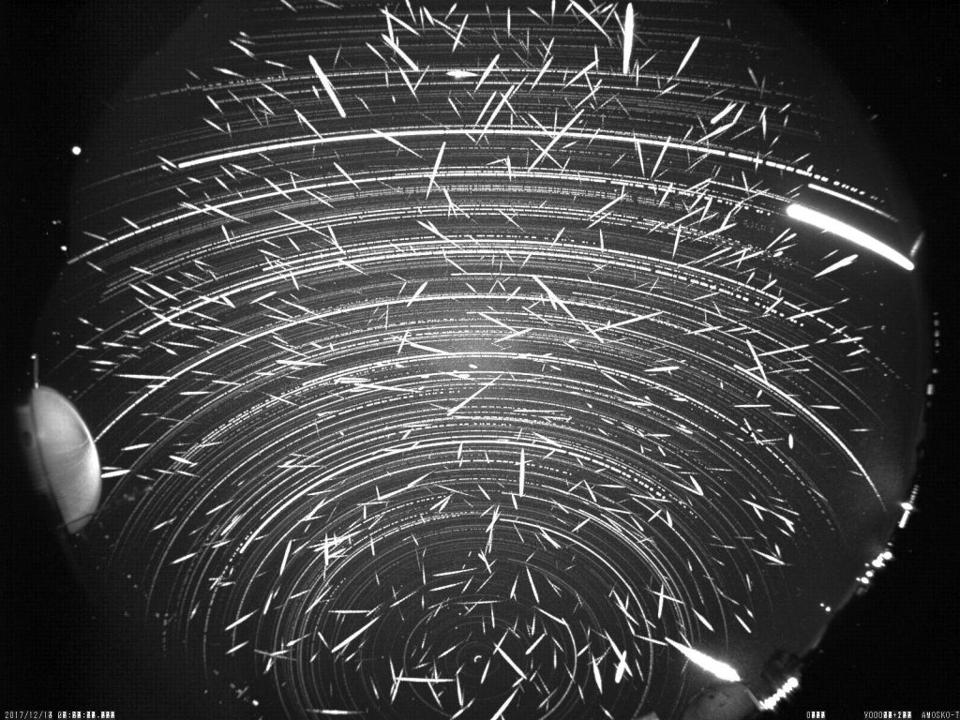 This composite of the Geminid meteor shower was taken over the course of one night during the peak, December 13/14, in 2017. It was captured by the All-sky Meteor Orbit System in Tenerife, Spain. Approximately every three years, Earth makes three revolutions while the parent body of the Geminids (3200 Phaethon) makes two, resulting in above-average shows during these years. 2026 will mark the next such year.
Credit: Juraj Toth, Amos Team
This composite of the Geminid meteor shower was taken over the course of one night during the peak, December 13/14, in 2017. It was captured by the All-sky Meteor Orbit System in Tenerife, Spain. Approximately every three years, Earth makes three revolutions while the parent body of the Geminids (3200 Phaethon) makes two, resulting in above-average shows during these years. 2026 will mark the next such year.
Credit: Juraj Toth, Amos Team
That hasn’t been the case, however, and there’s an insidious reason as to why: light pollution. In the case of a meteor shower, it isn’t the local light pollution that can “dim” the Zenith Horizon Rate, as you can always move to a dark sky location to get a better set of observations. As viewed from Earth, however, there’s something that we cannot “subtract” from the sky no matter where we go on our world: the Moon.
A full or near-full Moon can serve as a tremendous source of light pollution whenever it’s in the sky, capable of transforming even a dark sky site into a sky that’s no better than one found near a large city. Remember, meteors are brief streaks of dust particles burning up in Earth’s atmosphere, and the brighter the overall sky is, the harder it is to see these brief streaks of light.
Dark skies are key to getting a good meteor shower, and if the Moon is present in the sky — especially if it’s near the full phase or if its location is close to the meteor shower’s radiant — the amount of “darkness” you’ll be able to achieve is severely limited. The Bortle scale, illustrated below, provides a measure of how pristine or dark your night sky can be. All by itself, a full Moon can take an otherwise pristine sky, like a 1-to-3 on the Bortle scale, and transform it into a 7 or 8, making the conditions for viewing a meteor shower far less than ideal. 2016’s Geminids had to contend with a 100% full Moon, and the ZHR was pathetic: just 25-per-hour at the peak.
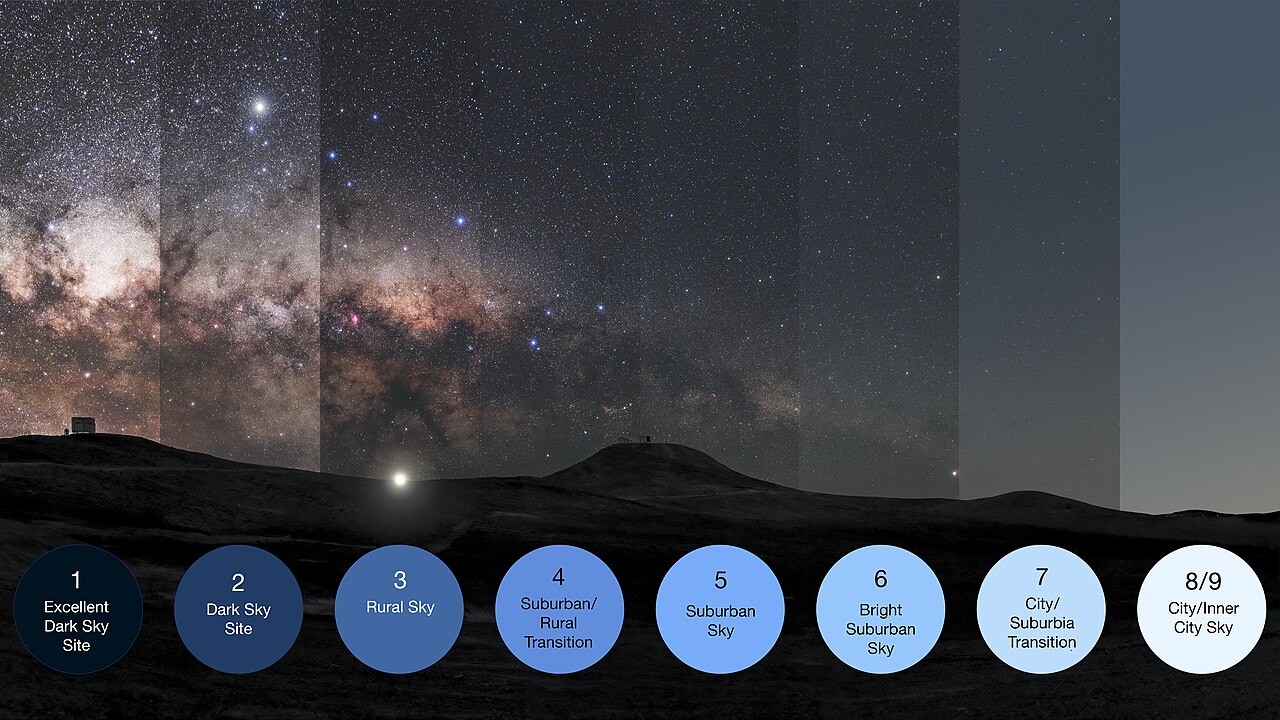 Under a pristine night sky, the Milky Way’s center casts shadows. As light pollution worsens, nebulosity and stars disappear, until maybe a few dozen stars remain. The numbers 1 through 9 are the Bortle scale, which provides observers with a metric to measure the darkness and clarity of the sky overhead at their location. Only a few locations remain on Earth with pristine, dark skies. A full Moon, by itself, can provide brightness equivalent to a 7 or 8 on this scale.
Credit: ESO/P. Horálek; M. Wallner
Under a pristine night sky, the Milky Way’s center casts shadows. As light pollution worsens, nebulosity and stars disappear, until maybe a few dozen stars remain. The numbers 1 through 9 are the Bortle scale, which provides observers with a metric to measure the darkness and clarity of the sky overhead at their location. Only a few locations remain on Earth with pristine, dark skies. A full Moon, by itself, can provide brightness equivalent to a 7 or 8 on this scale.
Credit: ESO/P. Horálek; M. Wallner
In 2026, when the next “three year peak” arrives,” the Moon will set relatively early: about 10 PM, meaning that the best viewing will occur from around 11 PM until around 4 AM, when skies are darkest. However, this year, in 2025, even though it’s a non-peak year, it will be the earlier viewing that creates the best views. That’s because the conditions on the night of December 13th/morning of December 14th will see a last quarter Moon: a Moon that won’t rise until between 2 and 3 AM, depending on your location on Earth.
That means, for the first part of the night, there won’t be a Moon in the skies at all. Once the skies darken and the constellations of Orion and Gemini rise high in the sky, viewing for the meteor shower will be ideal. Although the predicted ZHR for this year’s Geminids is “only” about 150 per hour, the best time for seeing the most Geminid meteors will be from about 10-11 PM until just before moonrise, or around 2-2:30 AM.
Although you can theoretically see Geminid meteors anywhere in the sky, my recommendation is to get out a lounge chair or blanket (and warm clothes!) and to simply look up in the general direction of the twin stars: Castor and Pollux. The Geminid meteors will all appear to radiate outward from one central point: the meteor shower’s radiant.
 The Geminid meteors all appear to originate from the same point in the sky: the radiant. Meteor showers are named after the constellation in which the radiant is placed, corresponding to the portion of the sky that intersects with Earth’s motion, causing the meteors to appear there. While only a small percentage of skywatchers can recognize the constellation of Gemini, marked by the twin stars Castor and Pollux, the nearby and much more widely-recognized Orion can serve as a guide.
Credit: E. Siegel/Stellarium
The Geminid meteors all appear to originate from the same point in the sky: the radiant. Meteor showers are named after the constellation in which the radiant is placed, corresponding to the portion of the sky that intersects with Earth’s motion, causing the meteors to appear there. While only a small percentage of skywatchers can recognize the constellation of Gemini, marked by the twin stars Castor and Pollux, the nearby and much more widely-recognized Orion can serve as a guide.
Credit: E. Siegel/Stellarium
A few decades ago, the Perseids were the only reliable meteor shower in town: spectacular year after year regardless of conditions. However, as Comet Swift-Tuttle, the parent body of the Perseids, travels farther and farther from the Sun, the rate of Perseid meteors has slowly but steadily dropped, while the rate of the Geminids has steadily grown. There have been recent years where the Geminids have even topped the Perseids as the leading meteor shower seen from Earth, and 2025 and 2026 both are years where this should happen. December’s Geminids might be the best meteor shower of the year, and 2026’s Geminids could provide the most prolific meteor shower of the 21st century so far!
Another feature of the Geminids that isn’t greatly appreciated, but is also worth commenting on, is that its meteors are often multicolored. You’ll never see “purple” or “pink” meteors, and there are no “green” ones either. However, a great many colors can be represented in a Geminid show, from red to orange to yellow to white and even a cyan-like blue. In collaboration with Big Think, I’ve created an infographic to help illustrate some of the most amazing “must-know” facts so that you can enjoy the December Geminids to the fullest!
 This infographic shows vital stats and information about the 2025 Geminid meteor shower, including where to look and what to expect. With a peak display of approximately 150 meteors-per-hour expected, the best time to view it is after the sky darkens and the constellation of Gemini rises, but before the Moon rises: between 2 and 3 AM, local time.
Credit: Big Think
This infographic shows vital stats and information about the 2025 Geminid meteor shower, including where to look and what to expect. With a peak display of approximately 150 meteors-per-hour expected, the best time to view it is after the sky darkens and the constellation of Gemini rises, but before the Moon rises: between 2 and 3 AM, local time.
Credit: Big Think
Of course, there’s one type of event that no amount of preparation can really protect you against: cloud cover on the peak night of the meteor shower. As is always the case in astronomy, clouds are a roll of the dice. If the weather cooperates, you’ll have a good show, but if it’s cloudy, you’ll have the same experience that many professional astronomers sometimes do of being “clouded out” of your astronomical hopes: you won’t be able to see anything at all, and your only recourse is to go somewhere else, to rely on the observations of others who have better luck with cloud cover, or to wait for the next observing opportunity. (Which, in the case of the Geminids, won’t arrive until next year.)
Sure, you can technically see Geminids for weeks on either side of the peak, but its peak remains narrowly collimated. Instead of 20-40 meteors-per-hour, which is what you might see within a day or two of the peak, seeing 100-150 (or even more) meteors-per-hour at the peak provides a notably improved experience. It was really in the mid-2000s that the Geminids began to become a more prolific meteor shower in Earth’s night skies, and it’s now — along with the Perseids — one of the two reliably spectacular meteor shower displays that graces Earth annually. In 2025, the Geminids may yet shape up to be the greatest natural show of the year!
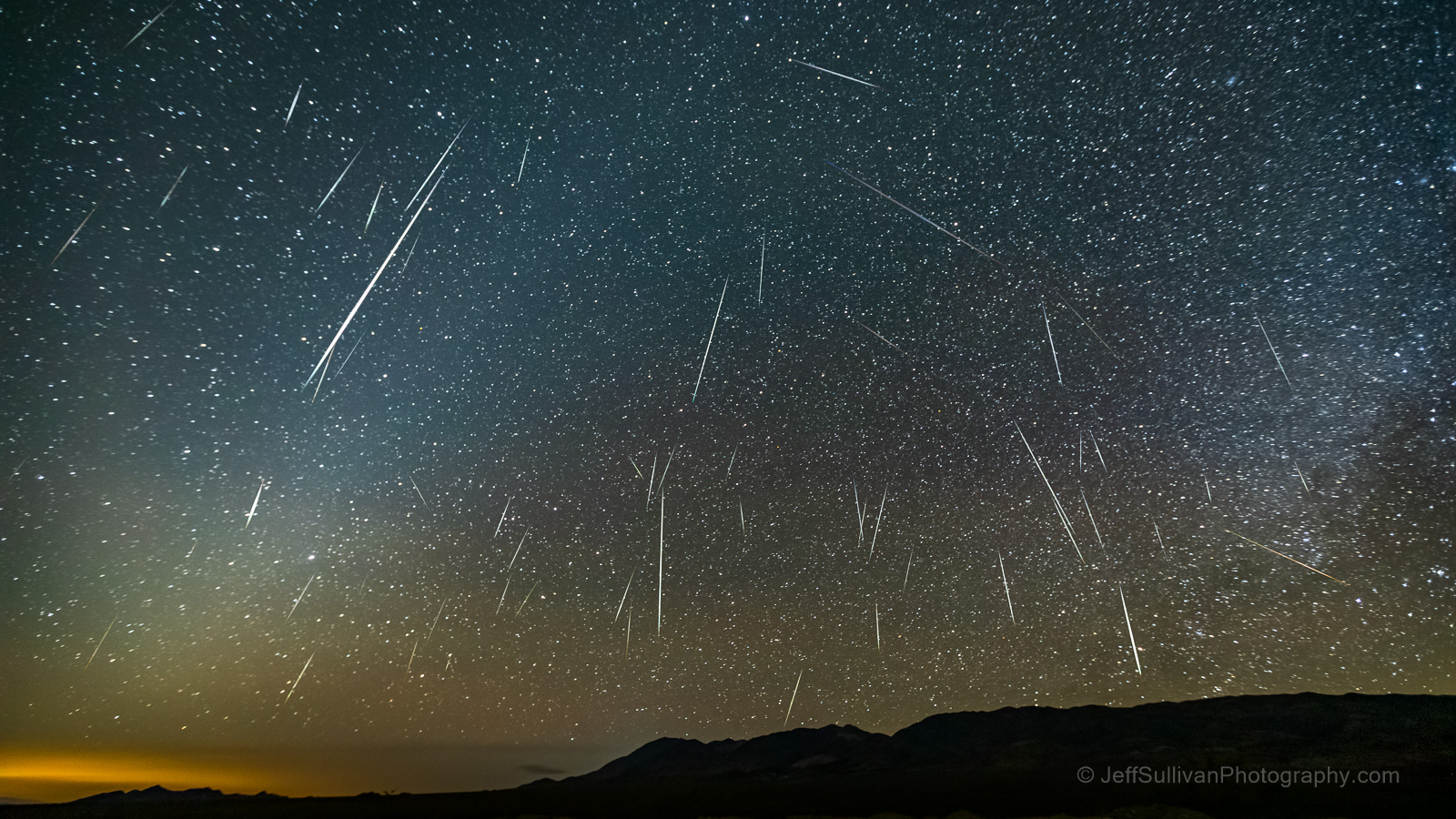 2020 was an excellent year for Geminid meteors, as captured in this composite during the night of the peak by Jeff Sullivan. While the shower is typically at its best every three years, the “off years” have recently also been remarkable as well, with 2021’s and 2022’s Geminids peaking at over 100 meteors-per-hour at the maximum. For 2025, the Geminids may well be the best meteor shower of the year, but 2026’s Geminids may explode as the best of the 21st century so far.
Credit: Jeff Sullivan/flickr
This is pretty remarkable for a meteor shower that’s relatively new to the game. Whereas the Perseids go back thousands of years, the Geminids were only first spotted in the year 1862. Initially, they were merely a modest meteor shower, with relatively small numbers of meteors that were described as somewhat faint. Even though their faintness has persisted, with the average Geminid perhaps +2 astronomical magnitudes fainter than a typical Perseid, their numbers have increased. Here in the 2020s, it’s the Geminids, not the Perseids, that have been the most reliably productive meteor shower in our skies.
And all of this suggests something fascinating: the notion that the orbital path that the parent body is on, asteroid 3200 Phaethon, is relatively new. It’s plausible that a gravitational interaction with one of the planets — perhaps even Earth itself — recently interacted with the asteroid, setting it into its current orbit relatively recently. Incredible, then, that the debris stream it’s generated has already grown so uniform, and perhaps this is an indication that the recent increase in Geminid activity is an early sign of further growth still to come. The 2025 Geminids could be the best of the year, but in future years, the Geminids may even become the best shower of all-time!
Tags Space & Astrophysics In this article Space & Astrophysics Sign up for the Starts With a Bang newsletter Travel the universe with Dr. Ethan Siegel as he answers the biggest questions of all. Subscribe